


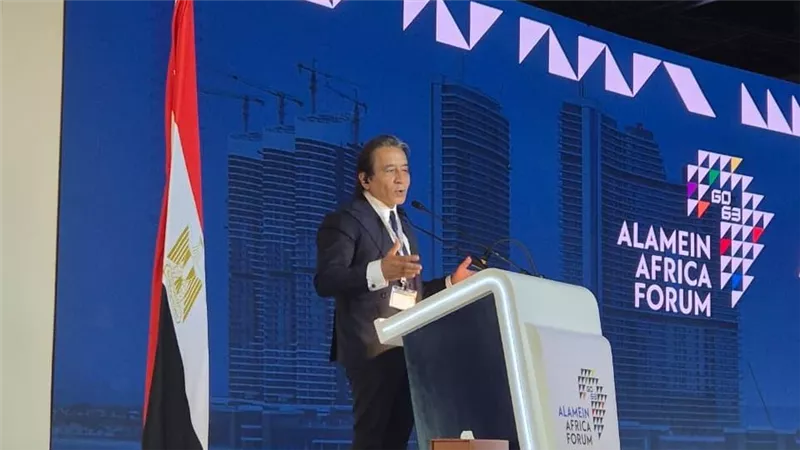
Ezz Calls on industrialists and investors to invest and produce within Africa
Eng. Ahmed Ezz, Chairman of the Board of Directors of Ezz Steel Company, affirmed that developing industry in Africa requires building an integrated industrial system, linked to competitive energy prices, the availability of transportation and ports, facilitating financing, and developing skills, in addition to opening markets to African products.
Ezz’s statements came during his participation in the first session of the “Alamein – Africa Business Forum 2026”, hosted by the city of New Alamein from October 2nd to 4th, under the patronage of President Abdel Fattah El-Sisi, and with the participation of leaders, officials, representatives of the public and private sectors, financial institutions, and investors from Egypt and a number of African countries.
The forum, launched on an Egyptian initiative approved by the African Union, serves as a continental economic platform aimed at enhancing trade, investment, and cross-border partnerships, and supporting the implementation of the African Union’s Agenda 2063 goals, with a focus on activating the African Continental Free Trade Area and strengthening the role of the private sector in economic development. The forum is organized in cooperation between the Egyptian government, the African Union Commission, the African Union Development Agency (AUDA-NEPAD), and the African Export-Import Bank (Afreximbank), and will be held biennially in the city of New Alamein.
The Free Trade Area: From Agreements to Actual Movement of Goods
Ezz stated that the African Continental Free Trade Area must be a key element in building the industrial system on the continent, noting that it includes 55 countries with a population of about 1.5 billion people, and a combined GDP of about $3.4 trillion.
He explained that the size of the African market alone does not guarantee success for manufacturers unless trade agreements are translated into an actual ability to transport products between countries at a reasonable cost and time.
Ezz questioned the ease of moving a product manufactured in Egypt to markets like Kenya or Ivory Coast, the time goods might take at borders, the recognition of standards and specifications, and the ability to meet delivery deadlines, considering these factors as essential elements in the competitiveness of industrial products.
He pointed out that the complexity of procedures and weak interconnections between markets largely explain the limited intra-African trade, emphasizing that the priority should not be to conclude new agreements, but rather to implement existing agreements and transform them into actual movement of goods and investments.
Steel as a Model for Industrial Integration
The Chairman of Ezz Steel cited the European experience in economic integration, explaining that the early stages of European integration were linked to the coal and steel sectors, when six European countries opened their coal and steel markets to each other in the 1950s.
He noted that steel production in those countries more than doubled in about 15 years, considering that industrial integration began with real production sectors before evolving into a broader system of economic integration.
This experience, according to Ezz, reflects the importance of placing industry at the heart of African integration efforts, so that economic relations between the continent’s countries are not limited to trade in final products or raw materials, but extend to building interconnected production chains, suppliers, and markets within Africa.
Infrastructure is Part of Industrial Capacity
Ezz stressed that industrial development cannot be separated from infrastructure, explaining that roads, railways, and ports are an essential part of the industrial system, due to their role in transporting raw materials and products and connecting production areas with consumption and export centers.
He pointed out that the African Union has identified about 12,000 kilometers of railways that the continent needs to establish, reflecting the size of the existing gap in transportation networks and the importance of investing in them to support trade and manufacturing.
Ezz cited the Egyptian experience in developing infrastructure over the past years, pointing to the expansion of electricity capacity and the development of electricity and gas networks, in addition to road and railway projects.
He explained that these investments will support economic and industrial activity, noting that Egypt needs a transportation system capable of handling about 14 million tons of goods annually.
Africa Needs Factories and Production, Not Just Investment Opportunities
Ezz affirmed that the next phase requires translating the talk about Africa’s significant investment potential into tangible industrial results, by increasing the number of factories and industrial clusters, and expanding the base of African companies capable of selling within the continent’s markets and competing in international markets.
He said that the continent has spent many years talking about its potential, but the current phase requires translating this potential into factories, production, investments, job opportunities, and African companies capable of competing with the best companies in global markets.
He added that the opportunity available to Africa is not permanent, which requires accelerating the building of a production base capable of leveraging the continent’s available resources and markets.
“Invest Here… Produce Here”
In a direct message to industrialists and investors in Africa, Ezz called for investing and producing within the continent, developing local technology and suppliers, and training cadres, emphasizing the need to view Africa as a production base for African and international markets, not just a consumer market.
Ezz’s vision reflects the importance of building an interconnected African industrial system, where the development of sectors such as steel and metal industries is part of a broader process based on competitive energy, infrastructure, ease of trade movement, market integration, and localization of technology and skills, thereby enhancing the competitiveness of African products within and outside the continent.