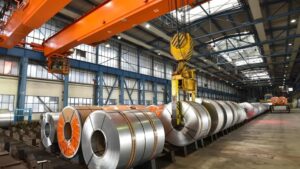



Environmental campaigners warn that the European steel industry risks missing its ambitious climate targets, despite billions of euros in support pledges by the region’s governments.
The non-profit research organization Aria indicated that the European Commission has approved grants worth more than 8 billion euros since 2022 to some of the largest producers in the bloc. To support investment in low-carbon production.
ArcelorMittal, the second largest steel producer in the world and the largest in Europe, has received pledges worth 3 billion euros to decarbonize its projects, by reducing the use of coal in favor of natural gas, and eventually using hydrogen. As for the German industrial group ThyssenKrupp, it received pledges worth two billion euros, while other groups such as Salzgitter received one billion euros. Tata Steel received 500 million pounds in support from the British government, under an agreement to invest 700 million pounds of its own funds.
Despite the support and subsidies, climate research groups announced that European steel manufacturers are not yet on the path to meeting emissions reduction targets, which allow them to limit global warming to 1.5 degrees Celsius, as stipulated in the climate agreement held in Paris in 2015.
“Steel groups have set ambitious targets, but if we look at the way they are currently operating,” said Vicky Sens, climate change and energy benchmarking officer at the World Benchmarking Alliance, which measures companies’ progress on the United Nations Sustainable Development Goals. “We would have found that it would not meet these goals.”
The coalition’s research found that carbon intensity, which measures the ratio of emissions to production by companies in heavy industries such as steel, needs to fall three times faster than its current rate over the next five years, to be in line with the 1.5°C target.
Industry analysts stressed the need to accelerate the transition to more environmentally friendly technologies, in light of the International Energy Agency’s expectations that global steel demand will rise from the levels recorded in 2020 by a third by 2050.
“The reality is that we are on a path that will take us to a temperature rise of 2.5 degrees Celsius,” said Rachna Mehta, principal analyst for the steel and raw materials sector at data provider Wood Mackenzie.
Other than power generation, the iron and steel sector is the largest industrial producer of carbon dioxide. Steel alone accounts for between 7% and 9% of all direct fossil fuel emissions, according to the World Steel Association. Wood Mackenzie estimates that decarbonizing the global iron and steel industries will cost $1.4 trillion by 2050.
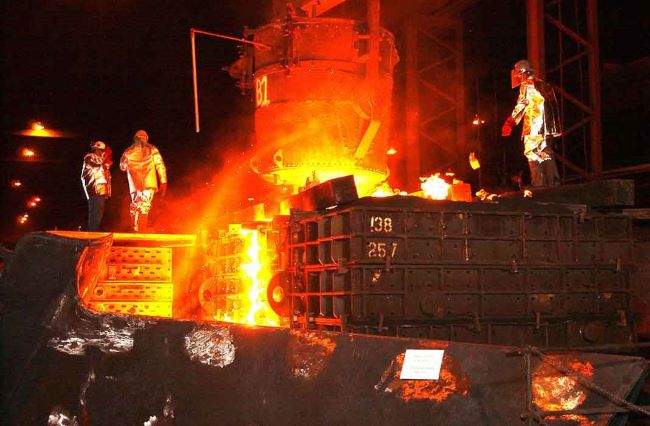
The majority of European steel groups invest in electric arc furnaces, which melt recycled steel and emit a fraction of the carbon dioxide emissions of conventional coke furnaces.
To meet net-zero emissions targets, the industry relies on a combination of sponge iron production plants and electric arc furnaces. Sponge iron plants use natural gas, and perhaps green hydrogen, which is not currently abundant, to extract pure iron from that ore. The intermediate product, sponge iron, is transformed into raw steel in an electric arc furnace.
In addition to criticizing the slow progress made by steel producers, climate activists have pointed to a lack of transparency, which makes it difficult to determine how much money is being spent on researching and developing lower-carbon alternatives.
The activist group Steelwatch, which was founded last year with the aim of putting pressure on the industry to decarbonise in line with the Paris Agreement, argued that ArcelorMittal in particular needed to do more, given its leadership position. Steelwatch called on the company to adopt more ambitious climate targets, set clear deadlines on ending the use of coal and gas in its operations, and invest more of its profits in decarbonization goals.
Caroline Ashley, director of Steelwatch, said: “We realize that changing policies and the market affect companies, but this company is the largest steel producer group in the world. “It is not a subsidiary of the market, but rather it shapes and shapes the market.”
For her part, Nicola Davidson, Vice President of Sustainable Development and Corporate Communications at ArcelorMittal, defended the company’s efforts, explaining that the company “is unable to reliably set a target for 2030 according to the Science-Based Targets Initiative methodology.” She continued: “We believe it is better to explain what can be changed so that we can confidently set a science-based target.”
The group, which is investing in several CO2 reduction projects, including carbon capture, announced that it will need $10 billion in order to meet 2030 targets to reduce the carbon intensity of the steel it produces by 25%. The group expects to get half that amount of money from public funding.
Despite major pledges to grant government subsidies in Europe, ArcelorMittal highlighted that it has not yet obtained any funding. The company pointed out that the funds will only become available when it begins building a project, and that it is contingent on “the transition to green hydrogen.”
The company hopes to issue an updated climate report, showing how it intends to achieve its 2030 goals before the end of this year. “People have woken up to the challenges of limiting the average global temperature increase to 1.5 degrees Celsius, but it has never been easy,” Davidson said.
For its part, ThyssenKrupp announced its “commitment to the Paris Climate Agreement concluded in 2015,” adding that “its steel production will be completely climate neutral by 2045 at the latest.”
Salzgitter, the second-largest German steelmaker, has received one billion euros in government grants and is investing about 1.3 billion euros to build its own green steel production capacity by 2026. The company said its goals were “science-based” and that it was following a “path 1.5°C climate change.
As for Tata Steel in the UK, which intends to build an electric arc furnace at its main site in the town of Port Talbot in Wales, it said it plans to set science-based targets. The company’s analyzes indicate that it will “achieve a science-based goal by moving toward electric arc furnaces.”
For his part, Adolfo Aiello, Deputy Director General of Eurofer, the trade body for the European steel industry, spoke out in defense of companies operating in the region, stressing that they were “the most ambitious” in trying to reduce emissions compared to companies in the United States and Asia.
According to Aiello, European companies proposed green transformation projects in 2021, but it took several years to obtain regulatory approval. He added that the European sector is not expected to move in isolation from the rest, in light of the success of most projects relying on the prices and availability of green electricity and hydrogen. He pointed out that the availability of this energy is not quick, and the prices of this energy are very high in Europe.
Source: Sylvia Pfeiffer – Arjun Neel Alim