


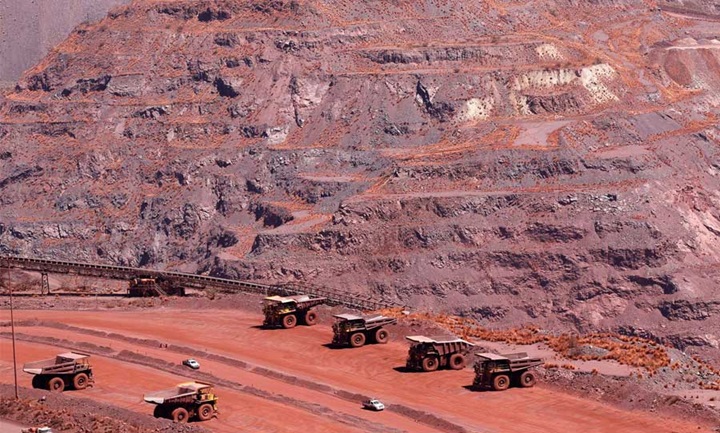
The 5 largest iron mines in the Arab world dominate the regional mining industry scene. They are strategic tributaries that support industrial security and help diversify sources of income in a number of countries.
Data from these mines reveals massive reserves exceeding 7 billion tons, making them a key driver of industrial growth and infrastructure development.
Iron, which heavy industries and construction rely on, is a pivotal element in economic development plans, especially in light of the trend toward reducing reliance on imports and strengthening local supply chains. This highlights the need to highlight the 5 largest iron mines in the Arab world to anticipate the future of regional mining.
According to data from the Washington-based Energy Platform, these major mines are distributed among Algeria, Egypt, Libya, Mauritania, and Saudi Arabia. They all share vast mineral resources, but differ in their level of development, extent of exploitation, quality of raw materials, and the technical and geographical challenges they face.
While some of these projects have reached the actual production stage, others are still under development or technical study. Overall, they represent a significant opportunity to strengthen the Arab industrial economy if properly utilized.
Ghar Djebilet Mine
The Ghar Djebilet mine in Algeria tops the list of the five largest iron ore mines in the Arab world, with estimated reserves of 3.5 billion tons of iron ore, of which 1.75 billion tons are directly exploitable.
Although its discovery dates back to 1952, its actual exploitation began in 2022, as part of an Algerian-Chinese partnership led by the National Iron and Steel Company (FERA) and the CMH consortium.
During the first phase (2022-2025), the mine will produce between 2 and 3 million tons annually, with production set to increase to 50 million tons annually starting in 2026, following the completion of a 950-kilometer railway line to the city of Bechar.
Wadi Al-Shati Mine
Located in southwestern Libya, the Wadi Al-Shati Mine is ranked among the top five iron ore mines in the Arab world, with reserves estimated at approximately 1.6 billion tons of iron ore.
The mine’s ores vary between oxidized, magnetic, and reduced, with iron contents ranging from 35% to 55%.
Despite its promising potential, actual exploitation of the mine remains limited due to logistical and technical challenges, including high impurities and transportation costs, as well as reliance on imported coke.
Nevertheless, investment opportunities in this mine remain significant, especially with improved political stability and the availability of modern technology.
Atomai Mine
The Atomai Mine in northern Mauritania is a promising project among the top five iron ore mines in the Arab world, with reserves exceeding 500 million tons, with the potential to increase to one billion tons.
The project is being developed by Takamul, a joint venture between the Saudi Iron and Steel Company (Hadeed) and the National Industrial and Mining Company (SNIM).
Mauritania aims to produce 10 million tons annually of high-quality iron pellets from magnetite ore containing 35-37% iron, to feed the company’s plants in Saudi Arabia and export the surplus.
The project includes the construction of two processing plants: one at the Atomai site with a capacity of up to 28 million tons per year, and the other a pelletizing plant in southern Nouadhibou. The two plants are connected by a 640-kilometer railway.
Production is expected to begin in 2029 using traditional open-pit mining techniques. IDOM has undertaken the engineering and infrastructure design, from the mine pit to the power and water lines.
Al-Jadeeda Mine
Located in the heart of the Bahariya Oasis in Egypt’s Western Desert, Al-Jadeeda Mine is one of the five largest iron ore mines in the Arab world.
The mine produces approximately 3.3 million tons annually and contains strategic reserves estimated at 134 million tons, with an iron content of 54.76%.
The mine has been a major source of iron ore used in the Helwan Iron and Steel Complex since the late 1960s, following the signing of an agreement with the Russian side to develop industrial production.
To serve the project, extensive infrastructure has been built, including a 330-kilometer road from Cairo, a 349-kilometer railway for transporting the ore, as well as electricity networks and water wells.
Mining operations are carried out using the terrace method to facilitate the extraction of raw materials. The ore is then transported to crushers, followed by homogenization and mixing to obtain consistent ore ratios before being shipped to factories.
Wadi Al-Sawawin Mine
The Wadi Al-Sawawin Mine in the Tabuk region of Saudi Arabia represents a cornerstone among the five largest iron ore mines in the Arab world.
The Wadi Al-Sawawin Mine is located 120 kilometers southwest of Tabuk and 45 kilometers northeast of Duba Governorate. Its total area is estimated at 57.3 square kilometers.
It is distinguished by its proximity to the port of Duba, as the distance between the mine and the port does not exceed 25 kilometers, which facilitates the transportation of iron for export or transport to factories. The Saudi Arabian Mining Company (Ma’aden) has obtained the concession to exploit this mine.
The deposits in the Wadi Al-Sawawin mine consist of magnetite, which spreads over a distance of 3 kilometers. Confirmed ore quantities amount to approximately 400 million tons, with a total reserve of 84 million tons and a proven reserve with a concentration of iron reaching 42.5%.
The Importance of the 5 Largest Iron Mines in the Arab World
The 5 largest iron mines in the Arab world embody the aspirations of industrial and mining development and represent strategic drivers of growth.
While the progress in developing these mines varies, providing adequate investment, modernizing infrastructure, and addressing technical and environmental challenges remain critical factors for maximizing their economic returns.
The development projects of the five largest iron ore mines in the Arab world are expected to play a pivotal role in transforming the regional economy, particularly with the broad trend toward enhancing local content and reducing dependence on imports.
attaqa