

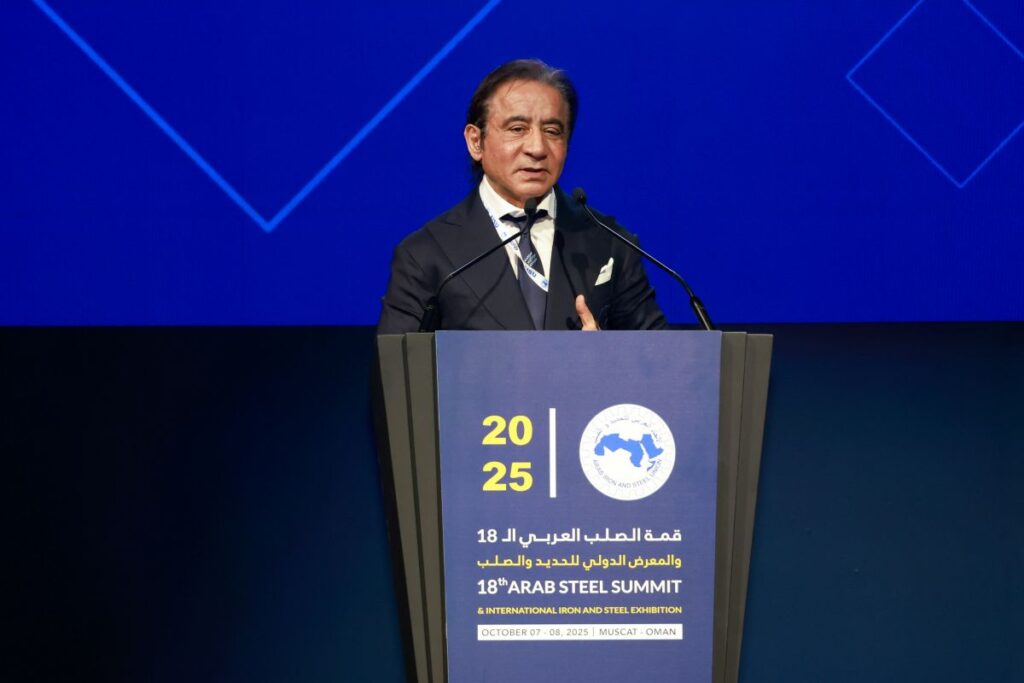
Eng. Ahmed Ezz, Chairman of the Arab Iron and Steel Union, welcomed H.E. Qais bin Mohammed Al Yousef, Oman’s Minister of Commerce, Industry and Investment Promotion, during the Arab Steel Summit held in Muscat, the Omani capital.
Ezz stated, “The world has changed. Although we have followed its developmental and commercial path for the past three decades — aligning our policies with the global economic system that upholds the values of free trade and a development model balancing domestic demand and the need for exports — we reduced tariffs, adhered to intellectual property protection, and signed trade remedy agreements. Despite accepting to be part of anti-dumping, subsidy, and safeguard measures in cases of export excess, those who promoted these ideas have now abandoned them. Markets are closing, barriers are rising, trade rules are disappearing, and the current global trade system is on the verge of collapse — as if the World Trade Organization no longer exists.”
He added that the United States, regardless of its changing administrations, has adopted a consistent approach of increasing protectionist barriers that harm international trade. The European Union has followed suit, imposing decreasing export quotas to its markets. “Even our Arab markets are now being accused of not adequately protecting themselves against dumped Chinese exports, while we, in turn, are accused of having surpluses to export simply because we don’t shield our industries enough,” Ezz noted.
Ezz emphasized the urgent need for “a unified and integrated Arab industrial policy specific to the steel sector — one that defines fair levels of protection, not because the steel industry is inefficient or weak, but to confront the ongoing waves of protectionism it faces.”
For his part, H.E. Qais bin Mohammed Al Yousef expressed his appreciation for the working paper to be presented by the Chairman of the Arab Iron and Steel Union, summarizing the conference’s recommendations and outcomes. He noted that these findings would be discussed with GCC Ministers of Commerce and Industry in their upcoming meetings.
The summit gathers decision-makers, producers, experts, and innovators to explore growth strategies, technological solutions, and collaborative models shaping the future of the steel industry.
The program features high-level conferences, strategic panel discussions, interactive workshops, and an exhibition showcasing the latest technologies and services. The summit aims to create a unique platform for partnership building and to forge a shared vision for a stronger, more competitive, and sustainable Arab steel sector.
The Arab steel industry faces major challenges, including global overcapacity, market volatility, environmental pressures, and rapid technological advancements. These factors require in-depth market studies and stronger strategic partnerships to maintain competitiveness.
Youm7