

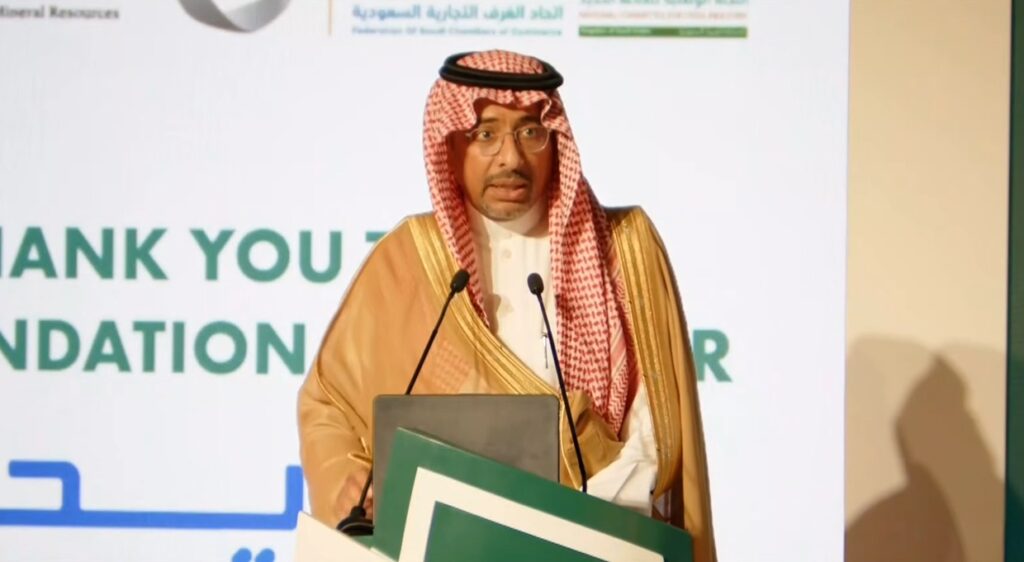
Minister of Industry and Mineral Resources Bandar bin Ibrahim Al-Khorayef revealed the completion of studies to determine the optimal options to address the local market deficit and reduce steel flat product imports. He noted that there are investment opportunities worth around SAR 60 billion, distributed across a range of key products vital to the Kingdom’s local industries.
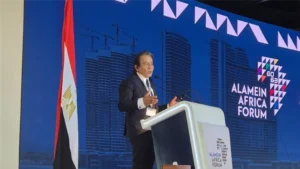
In his speech at the 3rd Saudi International Iron and Steel Conference 2025 held in Riyadh, Al-Khorayef stated that a study on the status of small-scale factories using induction furnaces to produce rebar has been completed, with the goal of enhancing their operational efficiency and sustainability in alignment with the future of the Kingdom’s industrial sector.
He added that, to keep pace with rapid developments, the National Industrial Development Center (NIDC) has been tasked with updating the national plan for restructuring the steel sector to align with both local and global developments, alongside reviewing relevant policies and regulations to promote sustainability and improve the investment environment.
Al-Khorayef explained that the steel industry has faced significant challenges in recent years, most notably the surplus in rebar production, limited production capacity for high-value steel products used in key industries, and intense competition from imports, which have reached nearly twice the Kingdom’s domestic flat steel capacity.
He emphasized that these challenges only strengthened the determination to restructure the sector, bridge production gaps, increase value addition, and ensure the sustainability of supply chains for the domestic, regional, and global economies.
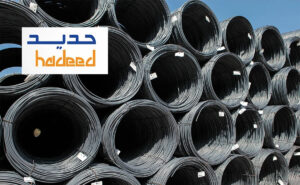
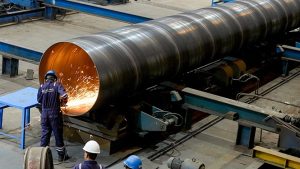
The minister highlighted several major achievements realized recently, including the establishment of Hadeed as an independent national entity specializing in steel products, the expansion into high-value steel products, the creation of Baab Al-Khair Company in partnership with Baosteel (China), Saudi Aramco, and the Public Investment Fund to produce heavy steel plates in Ras Al-Khair, as well as the reoperation of Solb Steel Company in Jazan and the merger of seamless pipe companies into a unified entity to enhance productivity and competitiveness.
Al-Khorayef urged companies in the sector to cooperate in implementing strategic recommendations, including the establishment of a Steel Academy to train national talent and the creation of a national company for importing and supplying scrap metal, given its direct impact on cost efficiency and sectoral growth.
He further noted that the sector is expected to continue its shift toward high-impact industries and high-value products, investing in advanced technologies that align with the Kingdom’s current economic momentum and enhance the global competitiveness of its exports.
Al-Khorayef pointed out that the steel sector holds a leading position globally in the market value of manufactured metals, making it a cornerstone of industrial supply chains. Recognizing this importance, the National Plan for the Restructuring of the Steel Sector was approved in August 2024, serving as a roadmap for the development, empowerment, and sustainability of the industry in line with global transformations.
He also stated that in September 2025, the Industrial Development Center completed a comprehensive study of the steel sector in the Kingdom, analyzing domestic market trends, consumption levels, import volumes, product specifications, and current and future standards. The study confirmed that the Saudi market is highly attractive for strategic investments that strengthen competitiveness, though certain gaps remain that require ongoing efforts to address.
The minister affirmed that the current renaissance of the steel industry is the result of strong collaboration between the public and private sectors, driven by a shared belief that the steel sector is a strategic backbone for key industries such as oil and gas, renewable energy, shipbuilding, automotive manufacturing, defense, and construction.
Finally, Al-Khorayef stressed that the Ministry of Industry and Mineral Resources will continue to collaborate with other key government partners — including the Ministry of Energy, Ministry of Investment, and Ministry of Environment, Water and Agriculture — to empower the steel sector through improved infrastructure, financing, policies, and supportive regulations.