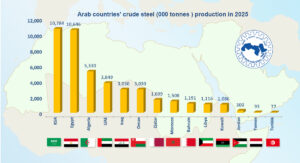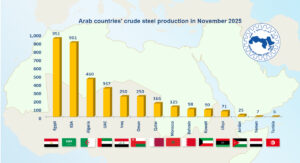


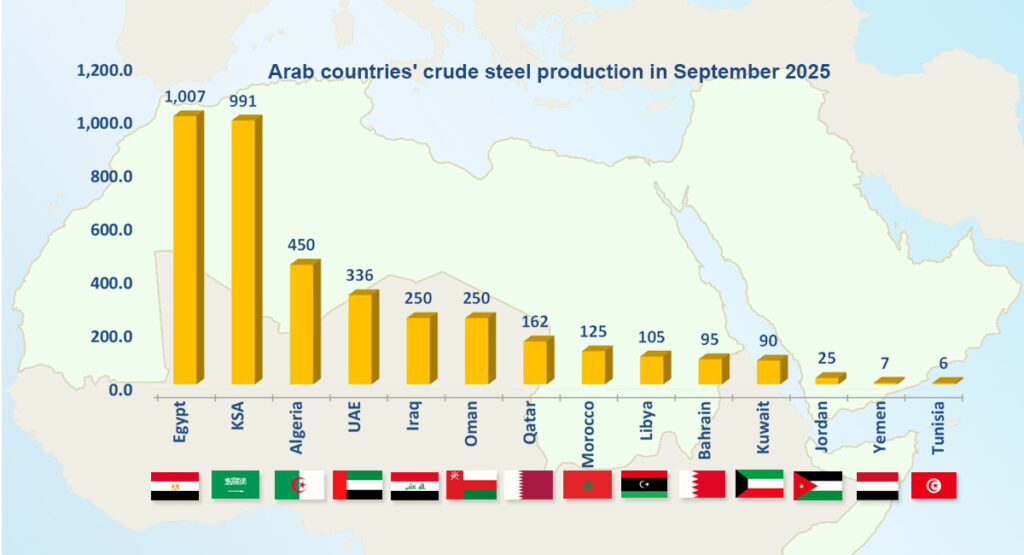
Crude steel production in Arab countries reached 3.9 million tons in September 2025, marking a 15.1% increase compared to September of the previous year. Meanwhile, total production from January to September reached 32.3 million tons, up 7.5% year-on-year, according to the latest data from the World Steel Association (World Steel). This reflects the continued recovery of the industry in the region and improved operating levels in several producing countries.
Gulf Area: Strong Growth
The Gulf region saw a 16.7% increase in crude steel production in September 2025, reaching 1.92 million tons.
Saudi Arabia led the region with 991 thousand tons, up 21.2%, benefiting from higher domestic demand and major infrastructure projects. The UAE recorded growth of 12% with 336 thousand tons. Qatar achieved a remarkable 75% increase, reaching 162 thousand tons, thanks to the return of some production lines to full capacity. Oman and Bahrain saw slight declines of 2% and 5%, respectively, while Kuwait’s production rose by 8.4%.
From January to September 2025, total Gulf production reached 15.96 million tons, up 9.7% from the same period last year, reinforcing the region’s position as the largest contributor to Arab steel production, accounting for nearly half of the total.
| Country | September 25 (000 tons) | Change – September 24/25 | Jan. – Sept. 2025 (000 tons) | Change – 24/25 |
| Saudi Arabia | 991 | 21.2% | 7,919 | 12.9% |
| UAE | 336 | 12.0% | 2,808 | 4.2% |
| Oman | 250 | -2.0% | 2,260 | -0.9% |
| Bahrain | 95 | -5.0% | 898 | -0.8% |
| Qatar | 162 | 75.0% | 1,265 | 41.3% |
| Kuwait | 90 | 8.4% | 811 | 5.9% |
| Total | 1,923 | 16.7% | 15,960 | 9.7% |
North Africa: Balanced Performance
North Africa’s production rose 16.4% in September to 1.69 million tons.
Egypt ranked first in the region with 1.01 million tons (+16.2%), despite a 3.2% decline in cumulative production since the beginning of the year due to slower domestic demand. Algeria maintained strong performance with 450 thousand tons (+12.5%), raising its total production since January by 23%. Libya recorded a notable increase of 70.8% for the month and 48.8% year-to-date, reflecting gradual production recovery. Tunisia saw a decline of 14.3%, while Morocco’s output rose 4.2%.
Total North African production for the first nine months reached 13.79 million tons, up 6.6% from last year.
| Country | September 25 (000 tons) | Change – September 24/25 | Jan. – Sept. 2025 (000 tons) | Change – 24/25 |
| Egypt | 1,007 | 16.2% | 7,694 | -3.2% |
| Algeria | 450 | 12.5% | 4,060 | 23.0% |
| Morocco | 125 | 4.2% | 1,125 | 6.1% |
| Libya | 105 | 70.8% | 852 | 48.8% |
| Tunisia | 6 | -14.3% | 58 | 7.4% |
| Total | 1,693 | 16.4% | 13,789 | 6.6% |
Eastern Mediterranean: Stable Production
The Eastern Mediterranean region maintained relatively stable crude steel output at 282 thousand tons in September 2025, a slight 0.7% decrease compared to the previous year.
Iraq maintained production at 250 thousand tons, and Jordan at 25 thousand tons. Yemen’s output fell 22.2% to 7 thousand tons.
From January to September 2025, total regional production reached 2.56 million tons, a marginal 0.2% increase compared to the same period in 2024.
| Country | September 25 (000 tons) | Change – September 24/25 | Jan. – Sept. 2025 (000 tons) | Change – 24/25 |
| Iraq | 250 | 0.0% | 2,265 | 0.4% |
| Jordon | 25 | 0.0% | 225 | 0.0% |
| Yemen | 7 | -22.2% | 72 | -7.7% |
| Total | 282 | -0.7% | 2,562 | 0.2% |
Total for Arab Countries
The overall performance of crude steel production in Arab countries during the first nine months of 2025 shows a continued upward trend, driven by increased domestic demand and production expansions in Saudi Arabia, Algeria, and Qatar.
Production in Arab countries is expected to continue growing in the final quarter of the year as new projects begin operations in some countries.
| September 25 (000 tons) | Change – September 24/25 | Jan. – Sept. 2025 (000 tons) | Change – 24/25 | |
| Arab Countries | 3,899 | 15.1% | 32,311 | 7.5% |