The Importance of the Iron and Steel Industry in Economic Development
The iron and steel industry plays a pivotal role in achieving sustainable economic development through:
- Supporting infrastructure and urban development projects.
- Supplying essential raw materials for manufacturing, engineering, and downstream industries.
- Enhancing the competitiveness of the industrial sector.
- Creating direct and indirect employment opportunities across a wide range of disciplines.
- Increasing the value added of natural resources and locally available raw materials.
- Promoting industrial exports and improving the trade balance.
- Attracting both domestic and foreign investments.
- Facilitating technology transfer and the development of technical competencies.
- Supporting the transition toward a knowledge- and innovation-based industrial economy.
The iron and steel industry is considered one of the leading industries that directly influences the performance of key sectors such as construction, energy, transportation, and mechanical engineering. Consequently, it represents a fundamental pillar of national economic development strategies.
Global and Arab Development of the Iron and Steel Industry
The iron and steel industry has undergone remarkable transformation since the Industrial Revolution. It has evolved from traditional furnace-based production to advanced technologies such as blast furnaces, direct reduction processes, electric arc furnaces (EAFs), and continuous casting systems, in addition to adopting automation, artificial intelligence, and digital transformation technologies.
In recent years, the global steel industry has increasingly embraced sustainability and decarbonization initiatives by expanding the use of steel scrap, improving energy efficiency, and developing low-carbon steelmaking technologies. These include the utilization of green hydrogen and carbon capture technologies to reduce greenhouse gas emissions.
At the Arab level, the iron and steel industry has witnessed significant expansion over the past decades through the establishment of integrated steel plants as well as facilities based on direct reduction technology and electric arc furnaces. This growth has been supported by the availability of energy resources, raw materials, and regional markets. Many Arab steel producers have achieved advanced levels of product quality and manufacturing excellence while continuing to invest in technological modernization and operational efficiency improvements.
Main Operations in the Iron and Steel Industry
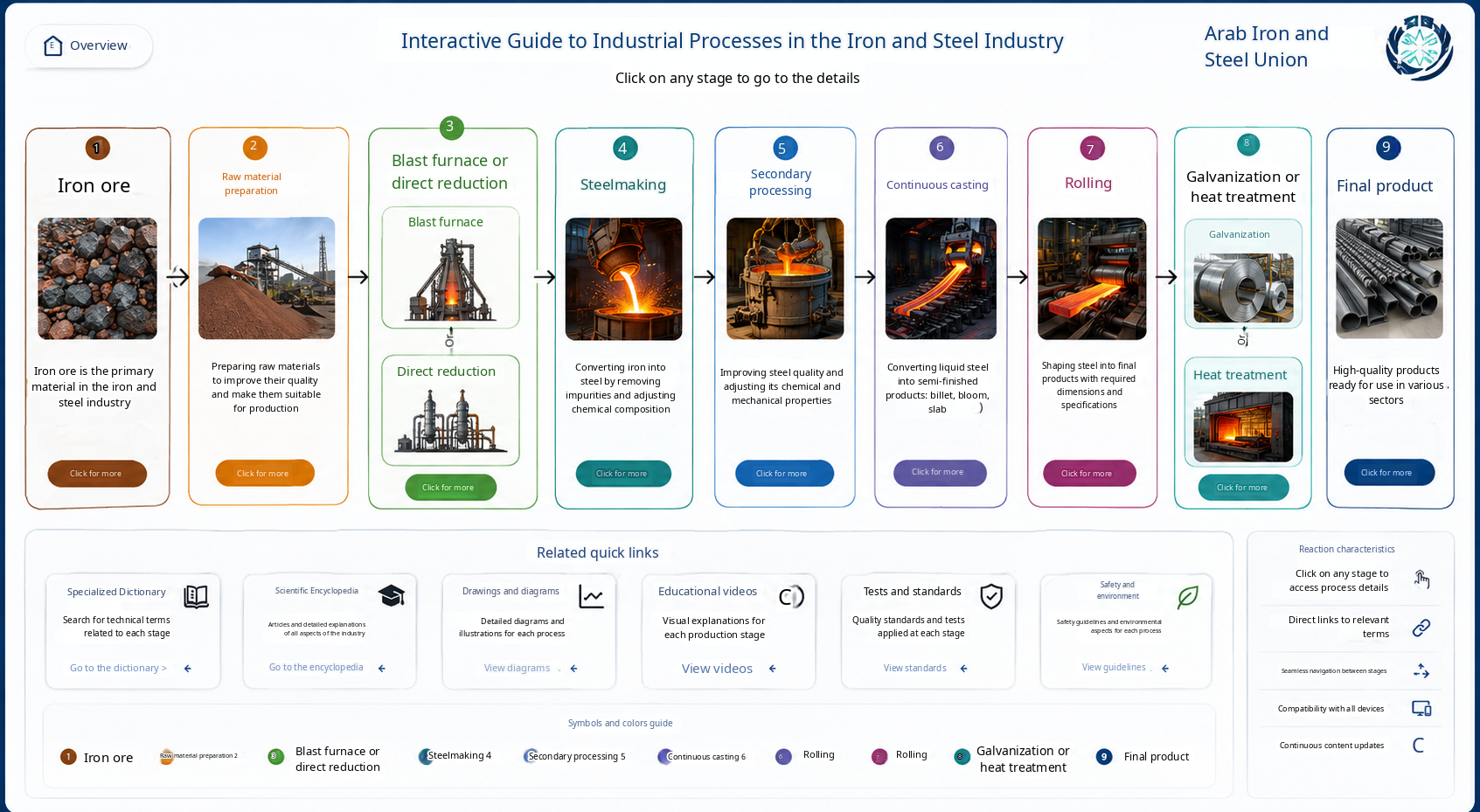
The iron and steel industry consists of a series of integrated manufacturing processes that begin with raw material receiving and preparation, followed by ironmaking, steelmaking, refining, casting, rolling, finishing, quality control, and shipment. Although production routes vary depending on the technology employed—either the Blast Furnace–Basic Oxygen Furnace (BF–BOF) route or the Direct Reduced Iron–Electric Arc Furnace (DRI–EAF) route—the fundamental production stages are similar in most steel plants.
1. Raw Material Preparation
Objective
To ensure that raw materials with consistent chemical composition and suitable physical properties are supplied to the production units, thereby improving productivity, reducing energy consumption, and ensuring the quality of the final steel products.
Main Raw Materials
- Iron Ore
- Iron Ore Pellets
- Sinter
- Coal
- Coke
- Limestone
- Dolomite
- Steel Scrap
- Direct Reduced Iron (DRI/HBI)
Process Steps
- Raw material receiving
- Sampling
- Weighing
- Chemical analysis
- Moisture determination
- Particle size analysis
- Storage
- Crushing
- Screening
- Blending and homogenization
Major Equipment
- Stacker
- Reclaimer
- Belt Conveyors
- Jaw Crusher
- Cone Crusher
- Hammer Crusher
- Vibrating Screen
- Blending Yard
Operating Conditions
- Moisture control
- Prevention of raw material contamination
- Consistent chemical composition
Outputs
Prepared and homogenized raw materials suitable for sintering, pelletizing, or direct reduction.
Quality Control Parameters
- Fe %
- SiO₂
- Al₂O₃
- CaO
- MgO
- Moisture
- Particle Size Distribution
2. Sinter Plant
Objective
To convert fine iron ore into porous sinter suitable for efficient operation in the blast furnace.
Inputs
- Iron ore fines
- Coke breeze
- Limestone
- Water
Process Flow
Mixing → Ignition → Air Suction → Sintering → Crushing → Cooling → Screening
Major Equipment
- Mixing Drum
- Ignition Furnace
- Sinter Strand
- Crusher
- Cooler
- Vibrating Screen
Operating Conditions
- Temperature: 1,200–1,400°C
- Controlled air flow through the sinter bed
Output
Sinter
Quality Control Parameters
- Crushing Strength
- Reducibility
- Basicity
- Iron Content
3. Pellet Plant
Objective
To produce high-strength iron ore pellets suitable for blast furnaces and direct reduction processes.
Process Flow
Grinding → Bentonite Addition → Pelletizing → Drying → Induration (Firing) → Cooling
Major Equipment
- Ball Mill
- Disc Pelletizer
- Rotary Kiln
- Induration Furnace
- Cooler
Operating Conditions
- Temperature: 1,250–1,350°C
Output
Iron Ore Pellets
Quality Control Parameters
- Pellet Diameter (10–16 mm)
- Compressive Strength
- Porosity
- Iron Content
4. Coke Oven Plant
Objective
To convert metallurgical coal into high-strength coke used as both fuel and reducing agent in the blast furnace.
Operating Conditions
- Temperature: 1,000–1,100°C
- Oxygen-free atmosphere
Major Equipment
- Coke Oven Battery
- Charging Car
- Coke Pusher
- Quenching Tower
Outputs
- Coke
- Coke Oven Gas
- Coal Tar
- Benzene
- Ammonia
Quality Control Parameters
- Coke Strength after Reaction (CSR)
- Coke Reactivity Index (CRI)
- Ash Content
- Sulfur Content
5. Blast Furnace (BF)
Objective
To produce molten iron by reducing iron oxides using carbon monoxide generated from coke.
Inputs
- Iron Ore
- Sinter
- Pellets
- Coke
- Limestone
- Hot Blast Air
Main Reduction Reactions
Fe₂O₃ → Fe₃O₄ → FeO → Fe
Major Equipment
- Bell-less Top Charging System
- Tuyeres
- Hot Blast Stoves
- Cast House
Operating Conditions
- Temperature: Up to 2,200°C
- High-pressure hot blast
Outputs
- Hot Metal
- Blast Furnace Slag
- Blast Furnace Gas
Quality Control Parameters
- Carbon Content
- Silicon Content
- Hot Metal Temperature
6. Direct Reduced Iron (DRI)
Objective
To produce metallic iron without melting the ore.
Inputs
- Iron Ore Pellets
- Natural Gas (or Hydrogen in future low-carbon processes)
Major Equipment
- Shaft Furnace
- Gas Reformer
- Cooling Unit
Operating Conditions
- Temperature: 800–1,050°C
Output
Direct Reduced Iron (DRI/HBI)
Quality Control Parameters
- Metallization Degree: 92–96%
- Carbon Content
7. Electric Arc Furnace (EAF)
Objective
To produce steel by melting steel scrap and/or direct reduced iron.
Process Flow
Charging → Melting → Slag Refining → Chemical Composition Adjustment → Tapping
Major Equipment
- Graphite Electrodes
- Furnace Shell
- Power Transformer
Operating Conditions
- Temperature: Up to 1,700°C
Quality Control Parameters
- Steel Temperature
- Chemical Composition
- Electrical Energy Consumption
8. Basic Oxygen Furnace (BOF)
Objective
To convert molten iron into steel by blowing high-purity oxygen into the melt.
Operating Conditions
- Pure Oxygen Injection
- Heat Duration: 15–20 minutes
Outputs
Liquid Steel
Quality Control Parameters
- Carbon
- Phosphorus
- Sulfur
9. Secondary Metallurgy
Major Equipment
- Ladle Furnace (LF)
- Vacuum Degassing (VD)
- Ruhrstahl-Heraeus (RH)
- CAS-OB
Objective
- Temperature adjustment
- Degassing
- Alloy addition
- Improvement of steel cleanliness
Quality Control Parameters
- Hydrogen
- Nitrogen
- Oxygen
- Non-metallic Inclusion Rating
10. Continuous Casting
Objective
To transform molten steel into semi-finished products.
Products
- Billets
- Blooms
- Slabs
Process Flow
Ladle → Tundish → Mold → Secondary Water Cooling → Withdrawal → Cutting
Quality Control Parameters
- Surface Quality
- Internal Soundness
- Straightness
- Dimensional Accuracy
11. Rolling Mill
Products
- Reinforcing Bars (Rebar)
- Wire Rods
- Hot-Rolled Coils
- Structural Sections
- Steel Plates
- Steel Bars
Process Flow
Reheating → Rough Rolling → Finishing Rolling → Cooling → Cutting → Packaging
Quality Control Parameters
- Dimensions
- Straightness
- Mechanical Properties
- Surface Finish
12. Heat Treatment
Processes
- Annealing
- Normalizing
- Quenching
- Tempering
Objective
To improve:
- Hardness
- Toughness
- Ductility
- Wear Resistance
- Fatigue Resistance
13. Finishing and Surface Treatment
Processes
- Pickling
- Galvanizing
- Organic Coating
- Polishing
- Cutting
- Slitting
Quality Control Parameters
- Coating Thickness
- Coating Adhesion
- Corrosion Resistance
- Surface Appearance
14. Quality Control
Typical Tests
- Chemical Analysis
- Tensile Test
- Impact Test
- Hardness Test
- Bend Test
- Ultrasonic Testing (UT)
- Radiographic Testing (RT)
- Magnetic Particle Testing (MT)
- Liquid Penetrant Testing (PT)
- Dimensional Inspection
15. Packaging and Shipping
Main Operations
- Bundling and Strapping
- Product Identification and Labeling
- Storage
- Shipment Preparation
- Loading
- Export
Quality Control Points
- Packaging Integrity
- Heat Number Traceability
- Compliance with Quality Certificates
- Protection Against Transportation Damage
Overall Steel Manufacturing Process Flow
Raw Material Preparation
│
┌──────┴──────┐
│ │
Sinter Plant Pellet Plant
│ │
└──────┬──────┘
│
Blast Furnace
│
Hot Metal
│
Basic Oxygen Furnace
│
Secondary Metallurgy
│
Continuous Casting
│
Rolling Mill
│
Heat Treatment
│
Finishing & Coating
│
Quality Control
│
Packaging & Shipping
OR
Raw Material Preparation
│
DRI Plant
│
Electric Arc Furnace
│
Secondary Metallurgy
│
Continuous Casting
│
Rolling Mill
│
Finishing
│
Quality Control
│Packaging & Shipping