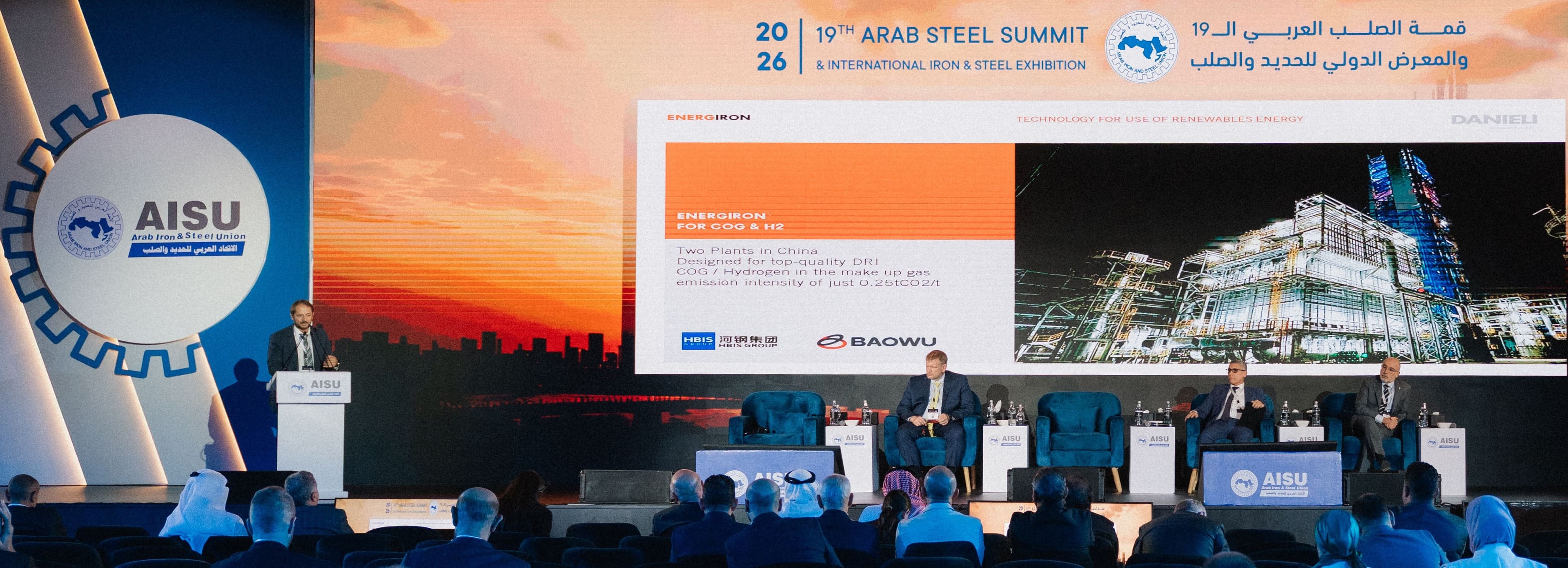
Direct Reduction Economics Session Discusses Securing Raw Materials, Energy, and Low-Carbon Production within the 19th Arab Steel Summit in Cairo
The session "Economics of Direct Reduction Iron Technologies: Accelerating the Transition Towards Low-Carbon Steel Production," during the second day of the 19th Arab Steel Summit organized by the Arab Iron and Steel Union in the Egyptian capital, Cairo, discussed the economic and technological requirements for expanding the adoption of direct reduction technologies. It also covered the role of natural gas as a transitional pathway for emissions reduction, alongside opportunities for a gradual shift towards hydrogen and enhancing plant readiness to accommodate low-carbon production technologies.
The session was moderated by Eng. El Sayed Ibrahim, Deputy General Manager – Ezz Steel, with the participation of K.C. Woody, CEO – Midrex Technologies, Stefano Maggiolino, CEO – Tenova HYL, and Marco Lapasini, Vice President – Danieli Centro Metallics.
Discussions focused on one of the strategic challenges for the Arab steel industry, which is securing iron ore and iron pellets with specifications suitable for direct reduction processes. This is to be achieved by developing local ores and enhancing concentration and pelletizing capabilities, thereby reducing reliance on external sources and supporting the security of production inputs. The session's scope also extended to opportunities for building an integrated Arab value chain, including renewable energy, water, storage, transportation, equipment, and research and development, as well as joint investments. This aims to enhance the economic feasibility of low-carbon steel projects and boost the competitiveness of Arab products in international markets.
El Sayed Ibrahim: Reducing steel industry emissions requires addressing their primary source in direct reduction plants
Eng. El Sayed Ibrahim, Deputy General Manager at Ezz Steel, affirmed that the Arab steel industry possesses a strong industrial base that qualifies it for the transition towards low-carbon steel production. He noted that Arab countries produced approximately 37.5 million tons of direct reduced iron during 2025, representing about 20% of global production. This reflects the region's significant position in the path towards a more sustainable and lower-emission industry. He explained that the discussions are not limited to technological aspects but also extend to how to leverage these technologies to support Arab countries in gradually reducing emissions in the iron and steel sector.
He presented a number of indicators illustrating global production volumes, pointing out that crude steel production reached approximately 1.89 billion tons in 2025, while direct reduced iron production reached about 151 million tons, equivalent to 8.2% of global crude steel production volume. He emphasized that this percentage reflects a comparison of production volumes and does not necessarily represent the share of crude steel produced using direct reduced iron.
He indicated that the Arab region, despite its crude steel production representing only about 8% of global production, possesses a significant production base in direct reduced iron, providing it with a strong starting point for the transition towards a low-carbon industry.
Regarding the carbon footprint, he explained that the average emissions are about 2.34 tons of carbon dioxide per ton of steel in the blast furnace route, compared to about 1.74 tons per ton of steel in the direct reduction and electric arc furnace route.
In his analysis of emission sources within industrial complexes relying on direct reduction and electric arc furnace technology, Ibrahim explained that the presented reference case assumes the use of 75% direct reduced iron and 25% scrap as the metallic charge for the electric arc furnace.
According to this case, the direct reduction plant accounts for approximately 47.5% of total emissions across the production chain. When considering only the operational emissions of the direct reduction and electric arc furnace plants, the direct reduction plant's share reaches about 62.5% of the total emissions.
He stressed that a real and substantial reduction in emissions cannot be achieved without addressing its main source within the direct reduction plant. He explained that this reduction could reach 75% when using high percentages of renewable hydrogen, in addition to relying on electrical energy and suitable raw materials. He pointed out that there is an alternative decarbonization pathway that can be currently applied in some production areas, through a set of measures that allow for immediate emission reduction. These include improving energy efficiency, increasing hot direct reduced iron (HDRI) charging rates to benefit from the heat retained in the product, in addition to improving electricity utilization and reducing carbon consumption, and studying carbon capture and storage or utilization options where feasible.
He added that these measures can coincide with the gradual expansion in the use of hydrogen, reaching higher percentages in the future, possibly up to 100%. He affirmed that the combination of direct reduction technology and the electric arc furnace provides a pathway that combines a mature and commercially available technology today with clear development steps to reach much lower emission levels.
He noted that the application of these solutions varies from one plant to another according to the age of the equipment, energy costs, and available infrastructure. Therefore, the challenge is not solely related to technological aspects but extends primarily to economic feasibility, which remains one of the main obstacles to expanding the production of direct reduced iron using hydrogen.
The cost of hydrogen determines the competitiveness of green iron.
In this context, the Deputy General Manager of Ezz Steel explained that the cost of hydrogen production represents one of the most important factors determining the economics of the transition. He pointed out that producing one ton of direct reduced iron using hydrogen requires about 50 to 60 kilograms of hydrogen. Therefore, an increase of one dollar in the price per kilogram of hydrogen leads to a tangible increase in the production cost of direct reduced iron.
He indicated that the presented assumptions show that achieving the economic competitiveness of green hydrogen compared to natural gas becomes more feasible when its production cost drops to about $1.5 to $2 per kilogram, taking into account carbon costs as well. He stressed that this result is linked to the assumptions used in the analysis and does not represent a fixed global price. This raises two fundamental questions regarding the actual economic feasibility of this transition, and how to ensure that the investments required for emission reduction do not weaken the competitiveness of Arab steel products.
He explained that the transition towards a low-carbon steel industry is not limited to providing energy and hydrogen only, as direct reduction plants, including hydrogen-based plants, require high-quality iron ore and pellets. He warned that developing hydrogen production capacity without securing the necessary pellet supplies for direct reduction could lead to a new form of dependence on external supplies.
In contrast, he pointed out that the Arab region possesses significant iron ore resources, particularly in Mauritania and Algeria. He noted that the opportunity lies in identifying economically extractable resources, expanding ore extraction, concentration, and pelletization. He emphasized the importance of these processes, given that the iron content, impurities, pellet quality, and mechanical properties directly affect the productivity of direct reduction plants, energy consumption in smelting furnaces, and the performance and profitability of the steel industry. He added that the next step is to establish additional capacities for producing pellets suitable for direct reduction technology. He stressed that the goal is not for each country to achieve self-sufficiency individually, but rather to build a more secure and stable Arab supply system that limits exposure to external market fluctuations.
Arab integration is a necessity for building an integrated green steel value chain.
Ibrahim moved to the regional dimension of the transition towards low-carbon steelmaking, considering that building an integrated value chain represents one of the most important strategic opportunities for the future of the Arab steel industry. He explained that the production of direct reduced iron and hydrogen cannot be viewed as an independent investment. Instead, it requires the development of an integrated value chain that begins with renewable energy, water treatment and desalination, then hydrogen production, storage, and transportation, providing suitable pellets for direct reduction, leading to the production and export of direct reduced iron and steel.
He pointed out that this chain also needs supporting infrastructure, including ports, energy grids, equipment, research and development, and financing. He added that the Arab region possesses a set of integrated strengths and advantages. Some countries have iron ore resources, while others have advantages in renewable energy. Meanwhile, other countries possess industrial capabilities, infrastructure, logistics, and capital. He noted that joint investment and regional cooperation can contribute to consolidating these elements within a competitive integrated value chain, instead of establishing separate projects. He questioned how to transform this regional opportunity into practical steps within existing and future steel plants.
There is no one-size-fits-all path for steel plants.
In conclusion, the Deputy General Manager of Ezz Steel affirmed that direct reduction is not an endpoint, but a launchpad towards a less emissive and more competitive steel industry. He clarified that the decision at hand is not about choosing a single step suitable for all plants, but rather about determining the appropriate path for each plant, while securing available raw materials, providing the necessary infrastructure, and enhancing regional cooperation.
He stressed that these challenges cannot be dealt with on an individual level, but require coordinating visions among steel companies, technology suppliers, energy grids, the mining sector, and relevant authorities, to ensure the transition to a low-carbon industry without harming its competitiveness.
KC Woody: The Middle East possesses strong potential to boost direct reduced iron production and transition to hydrogen.
KC Woody, CEO of Midrex Technologies, affirmed that the Middle East and North Africa region has a strong base to continue the growth of the direct reduced iron industry in the coming years, thanks to the availability of natural gas, the necessary infrastructure, and decades of accumulated operational expertise, in addition to growing opportunities for low-emission iron production. He explained that the region leads the world in direct reduced iron production, according to 2025 data, which gives it a significant advantage in building on the current production base and gradually transitioning to more sustainable production, leveraging accumulated expertise in operating existing plants.
He pointed out that the performance of direct reduction plants in the region reflects the great potential of this sector, noting that the Midrex plant, affiliated with Tosyali Company in Algeria, set a global record last year, with a production of 2.43 million tons, and continued strong performance this year. He added that plants operating throughout the region achieved record production levels last year.
In his review of future projects, Woody referred to the ongoing implementation of several new investments in the region and globally, including the Tosyali project in Algeria to establish a plant with a production capacity of 2.5 million tons per year, alongside other company projects in Qom, Iran, which include a plant with the same production capacity.
On the European level, he explained that a number of projects in Germany, including the Thyssenkrupp project, are still under construction and rely on a new technological approach that includes using a downstream melting unit for the direct reduction process, allowing the use of lower-quality iron ores in steel production via electric arc furnaces.
He also pointed to the ongoing implementation of the H2 Green Steel project in Sweden, which aims to establish the first large-scale industrial plant for iron production using hydrogen, alongside the Big River Steel project in the United States, whose cornerstone was recently laid. This project includes the construction of a major direct reduction plant with a capacity of 2.5 million tons per year and a steel production plant, with plans to establish an additional direct reduction unit in the future to meet regional demand.
He added that the MetalX project, announced in the past few weeks, involves investments for steel production with a capacity of 2.5 million tons per year in Iowa, USA, utilizing several units of Midrex technology. He emphasized that the common denominator among these projects is their design to operate on natural gas in the first phase, with the possibility of a gradual transition to hydrogen in the future, allowing for operational and economic efficiency at present and readiness for future low-emission production requirements.
3 Pillars to Enhance Industry Competitiveness
Woody stressed that new investments in the Middle East and North Africa region should focus on three main pillars: energy flexibility, raw material flexibility, and emissions handling flexibility, as these are essential factors for enhancing the competitiveness of the iron and steel industry and reducing the risks of technological transformation.
Regarding energy flexibility, he explained that the availability of natural gas at competitive prices gives the region a significant competitive advantage, especially compared to markets that rely on energy imports, such as Europe. He affirmed that starting plants with natural gas and then gradually transitioning to hydrogen, eventually reaching the possibility of using 100% hydrogen through Midrex technology, provides producers with great flexibility to keep pace with future requirements.
As for raw material flexibility, he indicated that the expansion of direct reduction plants will increase pressure on iron ore pellet supplies, necessitating the search for alternative sources and the development of technological solutions that allow the use of lower-grade ores.
He explained that Midrex is working in collaboration with Vale and other partners to develop ores named CBQ, aiming to provide an additional source of raw materials for direct reduction, in addition to utilizing post-reduction melting technologies that allow plants to handle lower-grade iron ores. He added that Midrex plants have already proven their ability to use iron ores that do not necessarily conform to the specifications of traditional blast furnace pellets, pointing to the success of several of the company's plants, including facilities in the region, in efficiently using lower-grade iron ores with suitable operational efficiency.
Carbon Capture and Modernizing Existing Plants
Regarding emissions reduction, Woody emphasized that the transition to hydrogen is not the only path for the iron and steel industry, as carbon capture, utilization, and storage (CCUS) technologies can also be leveraged. He noted that Midrex is working with Primetals and MHI to develop a technology that captures nearly all carbon dioxide emissions from exhaust gases.
He explained that this solution offers an advantage for Midrex plants through the possibility of dividing carbon capture systems into independent modules, allowing for the quantification of carbon dioxide that can be captured according to the needs of downstream beneficiaries, while the direct reduction process continues to operate normally and maintains the necessary carbon content in the product.
He stressed that innovation should not be limited to building new plants, especially given the large number of existing direct reduction plants in the region. He emphasized the importance of developing existing assets through digital solutions, improving operational efficiency, modernizing equipment, and implementing necessary technological upgrades, thereby preparing these plants for the future transition to hydrogen utilization.
Woody concluded by emphasizing that the proven operational performance of direct reduction plants in the region, the accumulated expertise in their operation, along with the flexibility to transition to hydrogen or implement carbon capture technologies, represent important factors for mitigating the risks of industrial transformation and providing a more stable path for future investments in the iron and steel industry.
Stefano Magliolino: A strong economic model and advanced technologies are key to the steel industry's success in facing market challenges
Stefano Magliolino, CEO of Tenova HYL, affirmed that possessing a strong and sustainable business model is the fundamental pillar for the success of steel companies, given the challenges facing global markets, whether related to price volatility, product availability in Chinese markets, financing capabilities, or inflation rates.
Magliolino explained that Tenova bases its solutions supporting the steel industry's success on two main pillars: direct reduction technologies and electric arc furnace (EAF) technologies. He noted that market developments confirm the increasing importance of large direct reduction furnaces, along with solutions compatible with hydrogen use, as a response to current and future industry needs, while the blast furnace no longer represents the appropriate solution for these requirements.
He pointed out that steel production using large EAFs requires extremely high operational capabilities, especially when targeting production levels similar to major plants, where furnace capacity reaches over 250 tons, with electrical power exceeding 250 MW. This imposes a set of technical and operational challenges that Tenova has managed to address through specialized technological solutions.
He added that the company has developed a system for charging raw materials from the side of the furnace instead of the traditional top charging, ensuring the homogeneity of the metallic bath within large-capacity furnaces. It also uses the patented Consteel electromagnetic system, along with adopting two feeding points for the furnace to prevent a drop in the metallic bath temperature during various operational stages. He noted that these solutions also include water cooling systems and direct electrical power supply to the system, enhancing operational efficiency in large furnaces.
Magliolino reviewed a number of industrial models already operating with this technology, including the Arvedi, Cozzi, and Boscovolo plants, as well as other projects under construction at Tata, Ternium, and Nippon Steel, in addition to the recently ordered HGM project.
EAF Efficiency and Emission Reduction Technologies
Regarding the steel production process using EAFs, Magliolino explained that Tenova offers a range of technological features that give these furnaces competitive advantages. Foremost among these is the ZeroForm roof design, which provides advanced solutions for improving production process efficiency by reducing operational movements and currents. He added that the company has worked on developing its technologies over the past years, demonstrating flexible gas consumption, along with the efficiency of the electric furnace body in achieving the required metallization levels, as well as operational reliability proven by industrial applications.
He indicated that carbon-related solutions offer additional economic opportunities for steelmakers, explaining that a number of companies have achieved returns through selling carbon credits, while for other companies facing emission-related costs, these solutions represent a potential source of additional revenue rather than remaining a burden on their operations.
In a related context, he noted that Tenova has developed advanced solutions for charging materials into the furnace, combining multiple technologies to enhance production efficiency. He cited a number of industrial projects and references related to iron production using hydrogen, including projects at Ternium and Sanbas, as well as other projects in the pilot and commissioning stages at Jinhui and Posco in Indiana, USA, in addition to projects related to iron production by HGM.
Hydrogen and the Development of Iron Production Projects
Maggiolino emphasized that Tenova views hydrogen-based iron production solutions as one of the future reference pathways for the industry, especially since they rely on the same production process and can be applied to existing facilities. He clarified that the current limitations associated with hydrogen use do not necessarily require a complete change in the production process, but rather allow for the provision and introduction of hydrogen into the process whenever it becomes available.
He reviewed a number of projects related to this technology, including two projects under construction in Koma, the GravitHy project in France, and a project in Azerbaijan that is still in its early stages. He explained that the company is designing solutions for hydrogen-based iron production projects tailored to the needs of small and integrated plants, as well as other consumers, taking into account the varying requirements and operating conditions of each project.
He touched upon the possibility of dealing with ores and materials with high carbon content, pointing to the potential shift towards producing pig iron by combining hydrogen-based iron production with smelting furnaces.
He concluded by noting that smelting furnaces have operational characteristics that differ from direct reduction furnaces. However, the proven feasibility of this process through industrial applications and projects, including the NEOM project in Australia, opens the door for developing hybrid solutions that combine direct reduction and smelting furnaces, which could provide a suitable pathway for future iron production applications.
Daniele: Availability of Renewable Energy and Hydrogen Opens New Horizons for DRI Production in the Arab Region
Marco Lapasin, Vice President at Danieli Centro Metales, affirmed that the transformations occurring in the European steel markets present significant opportunities for the Middle East and Arab countries to develop their direct reduced iron (DRI) and semi-finished product production. He pointed out that heavy reliance on the European market for exporting these products carries risks that necessitate market diversification and enhanced production capacities in the region.
Lapasin explained that there are expectations of increased production and trade flows, but these increases do not necessarily mean that all anticipated quantities can be produced, which calls for a degree of caution in dealing with market developments. He added that this represents an opportunity for the region, especially in light of trends related to DRI and semi-finished product production, and the possibility of directing a portion of production for export.
He indicated that direct reduced iron production projects have already begun to launch, emphasizing that the technology Danieli is developing and offering to the market aims to reduce energy consumption and achieve more stable and efficient operating levels.
He stressed that energy consumption is a key factor in selecting production technologies, alongside the necessity of reducing the carbon footprint and operational costs. In this context, he explained that the use of pneumatic material transport systems offers a significant advantage in terms of safety and operational efficiency compared to systems relying on moving mechanical parts.
He added that these systems provide higher levels of safety due to the absence of moving parts, and also allow for improved operational efficiency and reduced energy consumption. He affirmed that the results achieved by this technology are based on actual industrial applications, not just theoretical concepts, and that it has reached advanced operational levels in furnaces.
Regarding the transition to hydrogen use, Lapasin explained that the technology offered by Danieli is now ready for this transition, noting that the new projects the company is implementing are based on designs that allow for initial operation using natural gas, followed by the gradual introduction of hydrogen without the need for facility redesign or fundamental changes to its core structure.
He affirmed that this trend has become part of the plans for implementing new projects, noting that industrial applications have already begun installing this technology, with readiness for a gradual transition to hydrogen use. He added that this trend is not limited to Danieli alone, as Chinese companies have also begun operating facilities based on these capabilities.
He explained that these facilities are characterized by great operational flexibility, as they can operate using natural gas, hydrogen, or a mixture of both, allowing adaptation to energy supply developments and the requirements of the transition towards low-emission production. He pointed out that improving the efficiency of the production process within furnaces, by utilizing Direct Reduced Iron (DRI) and feeding it into the furnaces, represents one of the pathways that contribute to increasing energy consumption efficiency and improving operational performance.
Dealing with the fluctuations of renewable energy
Regarding the challenges associated with integrating renewable energy into direct reduction iron production processes, Labasine explained that the most prominent of these challenges is the intermittent availability of renewable energy sources throughout the day and month, which necessitates providing solutions that ensure the stability of the production process despite changes in energy supply levels.
He added that hydrogen storage represents one of the proposed solutions to deal with this problem, but it may impose additional burdens on projects. Therefore, developing production facilities with greater operational flexibility can contribute to reducing the need for hydrogen storage, improving the economic feasibility of projects, and lowering their carbon footprint.
He explained that one solution lies in the possibility of mixing hydrogen with natural gas, allowing for the maintenance of productivity levels and adaptation to changes in available renewable energy quantities, without significantly impacting operational continuity. He pointed out that another pathway involves expanding the direct electrification of industrial processes, explaining that this trend allows for the installation of parallel electrical units to existing facilities, which helps in gradually transitioning to electricity use without abandoning current production assets.
He explained that this model can allow the use of clean electricity and reduce the carbon footprint while maintaining the same productivity levels, without the need for massive investments to rebuild existing facilities, as electrical processes can be implemented in parallel with the natural gas-based production system.
Labasine concluded his statements by emphasizing that the future of the iron and steel industry depends on leveraging the available industrial assets in each country, whether direct reduction facilities or blast furnaces, and working to integrate them with new technologies, foremost among them direct electrification and hydrogen use, to achieve a gradual and effective transition towards low-carbon production.
Engineer Sayed Ibrahim: The balance between technological development and economic competitiveness is the basis for the Arab steel industry's transition to low-carbon production
Engineer Sayed Ibrahim, Deputy General Manager at Ezz Steel Company, affirmed that direct reduction technologies offer a significant opportunity for the Arab steel industry to transition to low-carbon production, noting that the success of this transformation is linked to achieving the appropriate balance between technological development and maintaining economic competitiveness.
He explained, at the conclusion of one of the sessions of the 19th Arab Steel Summit, that the discussions and presentations during the session highlighted three key messages related to the future of the Arab steel industry and the transition towards low-carbon production. He pointed out that securing reliable supplies of high-quality iron ore and iron pellets for direct reduction, along with providing low-carbon energy at competitive prices and the necessary hydrogen infrastructure, represents a fundamental requirement to ensure the industry's sustainability and enhance its long-term competitiveness.
He added that strengthening regional integration and expanding joint investments can play a pivotal role in transforming the strengths and complementary advantages possessed by Arab countries into an integrated and globally competitive industrial value chain.