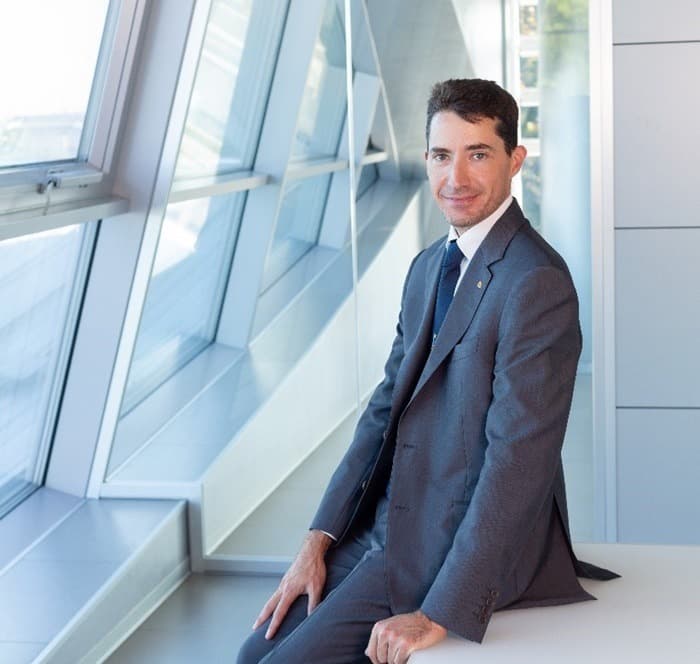
Never forget who you are and where you come from
• We possess the technology and expertise to sit at any table and compete for any project worldwide
• We are developing a new digital tool for steel plants that combines training, plant operation, and product simulation within a single environment.
• Robots will perform many physical tasks, and human expertise will remain essential for guiding artificial intelligence.
• The availability of competitive green energy and proximity to the market will determine the future geography of steel production.
• The steel plant of the future will receive raw materials and energy and deliver only reusable products; nothing will be wasted.
• Egypt possesses the most advanced steel industry in the region and is ideally positioned to play a role in the integration between the Middle East, North Africa, and Europe.
• The development of the steel industry in Egypt stems from developing the local manufacturing base and increasing the sophistication of downstream industries.
• Capital expenditures (CAPEX) and operational expenditures (OPEX) have always been at the core of every strategic decision in the steel industry.
• My advice to the next generation: Know your roots and constantly challenge yourself to improve.
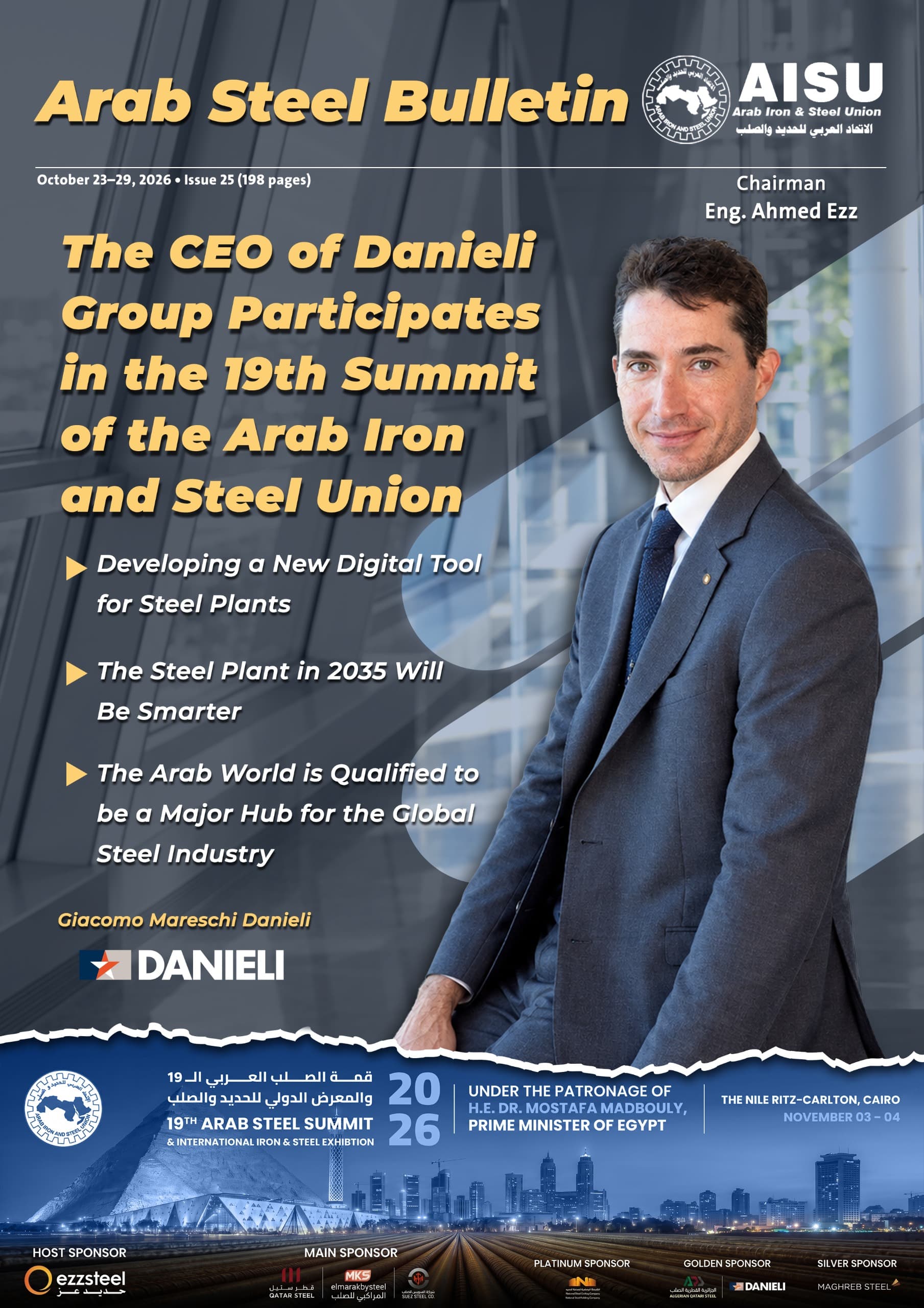
The dialogue with Giacomo Mareschi Danieli, CEO of the global Danieli Group, began spontaneously with the future. The vision adopted by his group transcends the traditional boundaries of the industry, bringing the future into the present. Meanwhile, adhering to roots and origins is a principle the Danieli family prides itself on.
"Never forget who you are and where you come from. We know where we started, what it took to get here, and the mistakes we made along the way." This is advice from Danieli, from his position at the top management of the global Danieli Group, to the next generation of the steel industry.
The meaning of these words goes beyond nostalgia for the beginnings. It is a reminder that industrial leadership remains more connected to its reality when it retains the memory of experience and understands the industry's needs from within. This is where engineering knowledge merges with operational expertise, and technology meets economics, giving this relationship a special meaning. Understanding the industry begins with its daily details, from the factory floor to investment decisions, from equipment performance to the needs of employees and customers.
In this context, Danieli discusses future technology in the iron and steel industry, emphasizing that robots will perform many physical tasks, while human expertise will remain essential for guiding this development and shaping the evolution of artificial intelligence applications.
Danieli believes that the steel plant of the future will receive raw materials and energy and deliver only reusable products and secondary materials; nothing will be wasted. He states that the steel plant in 2035 will be smarter and less reliant on fossil fuels.
He adds: "We are developing a new digital tool for steel plants, with the first demo expected in the coming months, which will combine training, plant operation, and product simulation, along with operational scenarios, within a single environment."
He also affirms that the availability of competitive green energy, along with proximity to the market, will increasingly determine the future geography of steel production.
An analysis of the industrial reality received ample attention in the dialogue, which covers numerous aspects including value and supply chains, green transition, decarbonization, and Digimelter technology, as Danieli discusses the forces influencing and driving the industry.
Danieli believes that the Arab world and the Middle East have the potential to become a major industrial and technological hub for the global steel industry. The region combines competitive energy with a significant logistical advantage, being strategically located between the mature markets of Europe and the rapidly growing markets of Asia and Africa.
Egypt and the Arab region are at the heart of the discussion. The region's experience in direct reduction, the availability of natural gas in some of its markets, its investment capabilities, and its location between Europe, Asia, and Africa provide it with the elements to enhance its role in the global steel industry.
Danieli believes these elements can support the establishment of a more influential industrial and technological hub, opening avenues for higher-value products and broader partnerships with European markets.
From engineering roots to leading a global group, from factory experience to the challenges of 2035, the dialogue opens a window into a philosophy that combines respect for accumulated human expertise with technological readiness for change.
.
From Manufacturer to Technology Partner
• Danieli has evolved from a traditional equipment manufacturer to a global technology partner covering almost the entire steel industry value chain. From your perspective, what is the most profound change occurring today in the relationship between steel producers and technology suppliers?
• Most steel producers are seeking a genuine partnership that goes beyond the traditional supplier-customer relationship. Technology evolves daily. While mechatronic equipment is relatively mature, digital innovation creates significant opportunities and advances at an exceptional pace. A strong partnership helps steel producers keep up with this rapid development.
However, the partnership should not lead to a blurring of roles. Customers and technology suppliers have fundamentally different goals, interests, and resources, and each party must remain focused on what it does best.
.
The Steel Plant in 2035
• If you were designing a steel plant from scratch for 2035, what would be radically different from today's plant – in terms of energy, raw materials, furnaces, automation, process control, and workforce?
• Nine to ten years is a long time, especially for digital technology, where the most significant changes are likely to occur. Artificial intelligence, particularly physical AI and robotics, will accelerate this transformation, reshape the workforce, create new roles, and demand higher levels of expertise.
Most technologies will move towards electrification, including the basic stages of steel production, with hydrogen playing a complementary role.
The steel plant of the future will receive raw materials and energy and deliver only reusable products and secondary materials. Nothing will be wasted, significantly reducing waste, emissions, and the overall environmental footprint of the steel industry.
Energy Decides the Future
• The steel industry has become increasingly dependent on the availability and cost of electricity and low-carbon energy. Do you believe the future geography of steel production will ultimately be determined by access to competitive clean energy rather than proximity to traditional raw materials?
• There are three key factors for a steel plant: market access, energy, and raw materials. Very few locations can offer all three together, and energy is certainly the most difficult to transport. Therefore, the availability of competitive green energy, along with proximity to the market, will increasingly determine the future geography of steel production.
Technological Transformation... The Electric Arc Furnace Revolution
• Electric arc furnaces are becoming increasingly important in the global transition to lower-emission steelmaking. To what extent can the EAF route realistically evolve in terms of productivity, energy efficiency, metallic yield, and carbon intensity?
• All these performance areas will continue to improve through better technologies and better management of scrap and other metallic inputs. High-quality scrap reduces energy consumption and increases metallic yield, while solutions like Danieli Digimelter can significantly reduce direct emissions compared to a traditional EAF.
However, the full scaling of the EAF route will ultimately depend on economics, particularly the cost of carbon and the price and availability of scrap, direct reduced iron (DRI) and hot briquetted iron (HBI). EAFs will only become dominant when carbon emissions carry a meaningful cost and sufficient competitive metallic inputs are available. The EAF is already the benchmark for environmental sustainability, and under the right conditions can even achieve net-zero CO2 emissions, but it is not yet economically competitive everywhere.
Direct Reduced Iron: A Bridge to the Future
• Danieli’s Energiron technology is designed to operate with natural gas and progressively increase hydrogen use. Do you see gas-based DRI as primarily a transitional technology, or a flexible long-term platform capable of adapting to different energy realities across regions?
• If the sole objective were to reduce emissions, the preferred route would be scrap-based EAF steelmaking. However, the industry also needs primary iron units, which must come from iron ore. Of the commercially available technologies, DRI currently offers the lowest-emission route for their production.
Natural gas will remain the main reductant for DRI in the coming years, while the same reduction plant can progressively switch to hydrogen without major modifications. But ultimately, the scaling of DRI will depend on the availability of natural gas at competitive prices. Where these conditions exist, we will see a significant expansion of DRI capacity, as is already happening in the MENA region and the USA.
Hydrogen: Between Technology and Economics
• The technical possibility of using hydrogen in direct reduction is advancing rapidly. From your perspective, what remains the stumbling block to widespread hydrogen-based steelmaking – is it the cost of hydrogen, renewable electricity, infrastructure, storage, or the economics of steel itself?
• Hydrogen-based steelmaking is not advancing rapidly because technology is no longer the primary issue. Our DRI plants are already capable of operating with up to 100% hydrogen. However, neither the required quantities of hydrogen nor the necessary economic conditions are currently available. The critical issue is the cost of hydrogen produced with today’s technology, which is still light-years away from the level required to make hydrogen-based steelmaking widely competitive.
Digimelter and the Next Generation of Electric Steelmaking
Danieli has developed the Digimelter system as part of its next generation of electric steelmaking technologies. What problem were you ultimately trying to solve with Digimelter, and where do you see its greatest potential in the global steel industry?
• Digimelter combines a suite of innovative hardware and software solutions. On the hardware side, Q-One is a digital power feeding system that precisely controls the power supplied to the electrodes. The mechanical design has also been revised to limit air ingress during operation, significantly reducing emissions.
On the software side, a combination of physics-based and data-driven models supports process control and reduces reliance on operator intervention. Together, these solutions reduce process inputs, particularly energy and electrodes, lower emissions, and simplify furnace operation. As a result, operators with average experience can effectively run the Digimelter (DDM) system.
Ultimately, we wanted to break the constraints that had guided EAF design for decades and focus on what truly matters: optimizing arc efficiency.
AI and the Smart Steel Plant
• AI, automation, and advanced process control are transforming industrial operations. What will AI actually change within a steel plant over the next decade – and where do you believe human expertise will still remain irreplaceable by technology?
• A decade is a very long horizon for AI, and the technology will drive profound changes across steelmaking operations.
Robots will perform many physical tasks, while AI will increasingly support operators and accelerate the transition towards autonomous plants. Human expertise will remain essential to guide this development and shape the evolution of AI applications.
We are also developing a new digital tool for steel plants, with the first pilot expected in the coming months. It will combine training, plant operation, and product and operational scenario simulation within a single environment. We are not ready to reveal more details, but it could change the way people interact with a steel plant.
Raw Materials, Carbon, and Competitiveness
Scrap: A Strategic Raw Material
• As EAF capacity expands worldwide, competition for high-quality scrap is likely to intensify. How should steelmakers rethink scrap sourcing, preparation, and optimization, particularly as alternative metallic materials like DRI and HBI gain importance?
• Effective scrap management will be essential to optimize the performance of the melting shop and reduce the cost of the final steel. Scrap sourcing is already changing, with forward-thinking steelmakers having greater control over the supply chain.
Scrap preparation will become equally important. Steelmakers will need the flexibility to purchase whatever scrap is available and economically attractive, then process it to make it suitable for their production route. The goal will be to select the most competitive metallic mix day-by-day, according to market conditions. This will require greater investment in scrap preparation and management equipment.
Can Green Steel Be Competitive?
• The steel industry is being asked to decarbonize while maintaining global competitiveness. Can low-carbon steel become commercially competitive without significant political support, or must the industry develop a radically different economic model for green steel?
- Our solutions can significantly reduce emissions, and in subsequent steel processing, the technological route is largely available. The real challenge lies in the upstream stages, particularly in primary steelmaking.
In the end, decarbonization will not happen at scale unless it becomes economically competitive. Technologies capable of producing steel with very low emissions have been available for many years, but their adoption has remained limited because the economics are not yet competitive. Therefore significant political intervention will be necessary to create the economic conditions that make low-emission steel competitive compared to traditional production.
Beyond decarbonization
• The global steel industry is currently very focused on CO2 reduction, but looking beyond carbon, what other technological challenges – water, raw material efficiency, waste, circularity, productivity or digitalization – will define the competitiveness of steel plants for the next generation?
• I would not say that the industry is focused only on CO2. CO2 is what we talk about most today, but CAPEX and OPEX have always been at the core of every strategic decision in the steel industry, including the efficient use of raw materials, energy and other resources.
CO2 itself has become a cost and therefore increasingly influences strategic decisions. The same applies to every resource: the more expensive or scarce it becomes, the greater its strategic importance to use it more efficiently. Water is a good example. In some regions, it has already become a catalyst for industrial development and if current trends continue, it will become increasingly critical in many other parts of the world.
It is true that for some years, CO2 performance has been a major factor in financing and investment decisions. This focus is now gradually evolving towards a more holistic and balanced view of economic, environmental and industrial sustainability.
Egypt and the Arab World
Egypt: A Long-Term Industrial Partnership
• Danieli has accumulated decades of experience in Egypt, working with major steel producers in Direct Reduction, EAF steelmaking, continuous casting, rolling mills, automation, and recently major revamping projects. How do you assess Danieli's experience with the Egyptian steel industry over this period? And what has Egypt taught Danieli about the evolution of the steel industry in emerging markets, and where do you see the most important opportunities for the next phase of the Egyptian steel industry?
• Egypt is not only one of the largest steel producers in the Middle East and Africa, but it also possesses the most advanced steel industry in the region. Over the years, we have observed that the evolution of the steel industry and product mix closely follows the development of the local manufacturing base and the increasing sophistication of downstream industries.
Looking ahead, we believe the next phase of growth will be increasingly focused on high-quality long products, particularly Special Bar Quality (SBQ) and wire rod, along with the production of plates for high-value applications, including sectors linked to defense, heavy engineering, and advanced manufacturing. These sectors offer a significant opportunity for Egypt to further enhance its industrial capabilities and upscale itself as a leading steel hub in the region.
Egypt: From Direct Reduced Iron Expertise to Green Steel
• Egypt has decades of experience in gas-based Direct Reduction and is now exploring a broader transition towards lower-emission steelmaking. What would you consider the most important technological and investment priorities for Egyptian steel producers over the next five to ten years?
- Egypt has extensive experience in the Direct Reduced Iron-based steel industry and already possesses a strong and competitive industrial base. The opportunity for the coming years is to build on this expertise, leveraging further developments in raw material flexibility, electrification, CO2 capture, automation, and digitalization to make this pathway more competitive and sustainable.
At the same time, the next phase of development should not only focus on reinforcing what already exists but also on building industrial capabilities in areas that are still missing, or no longer present, in the Egyptian steel industry. Plate and seamless pipe production are good examples, especially as Egypt continues to develop its energy, infrastructure, and manufacturing sectors.
The combination of Egypt's established DRI-based steelmaking platform with a broader range of higher-value products could represent a significant next step for the industry.
The Arab World and the Middle East: From Projects to a Regional Steel Strategy
• Danieli has made a significant technological footprint across the MENA region, from Egypt and Algeria to the UAE and Saudi Arabia, working across different generations of steelmaking technologies. Looking at the region as a whole, do you see the Arab World and the wider Middle East evolving into a distinct industrial and technological hub for the global steel industry – particularly in DRI, EAF steelmaking, and low-emission steel? And what role does Danieli aspire to play in this transformation?
- Certainly. I believe the Arab World and the Middle East have the potential to become a major industrial and technological hub for the global steel industry. The region combines competitive energy, natural gas, a strong DRI and EAF base, and significant investment capacity. It also has a major logistical advantage, being strategically located between the mature markets of Europe and the fast-growing markets of Asia and Africa. Furthermore, the relative youth of its steel industry has allowed many producers to adopt the latest technologies without the constraints of older industrial assets.
This has created the conditions not only for expanding steel production but also for them to become a reference region for the next generation of low-emission steelmaking and advanced steel products.
Danieli has been particularly successful in this region not only because of our technology but also because we share a similar industrial culture: pragmatic, entrepreneurial, and results-oriented. We understand each other well, and this has helped us build long-term partnerships rather than just supplier-customer relationships.
Our ambition is to continue playing a leading role in this transformation, bringing advanced technologies and supporting our customers in developing the next generation of competitive and sustainable steel plants.
The Arab Steel Industry and Europe
• Europe is simultaneously pursuing decarbonization, industrial competitiveness and stronger trade protection. Can MENA producers and European steelmakers become partners within a cross-regional low-emission value chain rather than just competing for the same market?
• Yes, absolutely. I believe this is the direction we should be heading. Europe and the MENA region should not simply view each other as competitors, but rather as two regions possessing different and complementary strengths.
The opportunity lies in building a more integrated industrial relationship: complementing each other, supporting each other and developing a stronger value chain together. The MENA region possesses competitive energy, raw materials and a strong base in the basic steel industry, while Europe has a highly developed industrial base, technology and important end markets.
Oman is a good example of this trend, with new production capacity that could potentially supply the European market while aligning with Europe's vision for decarbonization. Egypt, with its strong and established steel industry, strategic geographical location, and long experience in direct reduction-based steelmaking, is also ideally positioned to play an important role in this MENA-Europe integration.
If we focus on integration rather than competition, both regions can become stronger together and more competitive globally.
Technology, Partnership and Danieli's Global Role
Technology Transfer and Industrial Development
• For emerging steel-producing countries, the challenge is not simply acquiring equipment but developing technological capabilities and human expertise.. What distinguishes a successful technological partnership from a traditional equipment supply relationship?
- That’s a very interesting question, and I have a strong view based on both my direct experience and Danieli’s long history of working with producers and emerging markets. Many of our customers have become lifelong partners, in some cases across different generations.
Developing human expertise and technological capabilities is essential, of course, but I believe the most important decision is the industrial mindset you choose to build from the start, and then consistently pursue through every decision you make.
A new producer, for example, can start with a low-investment approach or choose first-class equipment and technology from day one. Both are legitimate choices, but they create entirely different industrial cultures. Once that mindset becomes part of the company, it is very difficult to change.
And this is where a long-term technology partner can make a real difference: not simply by supplying equipment, but by helping the customer build the capabilities and industrial culture that can support their ambitions over time.
Danieli's Global Ambition
• Danieli operates across very different industrial environments, from highly regulated European markets to fast-developing steel-producing regions. What is Danieli’s strategic ambition for the next decade, and where do you see the biggest opportunities for technological growth?
- Our biggest technological opportunities are in electric steelmaking, scrap preparation and management, and direct reduction. At the same time, we still have significant opportunities to increase our market share in specific markets, products, and customers where our presence remains below our potential.
Compared to 20 or 30 years ago, Danieli is in a very different position today. We now have the technology, the references, and the expertise to sit at any table and compete for any project worldwide.
Our ambition is simple: in every product and technology we offer, we want to be able to set the benchmark for the industry. In many areas, we are already there; in others, we acknowledge we have work to do. That is what will continue to drive our investment in technology and innovation.
The Human Factor
• You started your career working close to steelmaking operations and later gained extensive international experience, including management roles and projects in different markets. How has that experience shaped your understanding of what steelmakers truly need from a technology partner?
- At Danieli, the opportunity to experience the production side is available to everyone, and I think that’s extremely important. Understanding the processes from the shop floor gives you a completely different perspective on technology and what customers really need.
My direct operational experience, combined with many years of working with customers in different countries, has taught me that steelmakers don’t just need the best technology on paper. They need solutions that work reliably under real operating conditions and consistently deliver the expected results.
But there is another equally important element: understanding and managing customer expectations. Expectations don’t always perfectly align with the technology or even the contractual framework. And whether they are technically or contractually justified or not, unmet expectations will ultimately create an unhappy customer. So a true technology partner needs to understand the customer deeply, not just technically, but from a human and psychological perspective as well.
That’s why I believe a good technology partner should understand the customer’s process, their goals, and their expectations before trying to optimize them. This approach is part of Danieli’s culture, and almost all our senior managers have followed a similar path in their careers.
The Next Generation
A Message to the Next Generation
• The steel industry is undergoing one of the most profound technological transformations in its history.. So what advice would you give to the next generation of steel industry executive engineers who will design and operate the steel plants of 2040 and beyond?
- Over the past 40 years, Danieli has grown significantly by delivering projects across different regions and technologies. This breadth of experience has constantly challenged us to inquire, learn, and innovate in order to deliver results.
Hard work and calculated risks are essential for progress. Mastering emerging technologies, especially digital solutions and AI, will be indispensable, but strong traditional engineering expertise will remain equally important.
My advice is simple: work hard, take calculated risks, stay curious, and never be fully satisfied with what you have achieved, as there is always room for improvement. But at the same time, never forget who you are and where you come from. We know where we started, what it took to get here, and the mistakes we made along the way. Making mistakes is part of progress, and what matters is recognizing them, correcting them, and learning from them. Knowing your roots while constantly challenging yourself to improve is, in my opinion, essential for the next generation.
Conditions for a Competitive Steel Future
• If you had to identify one technological achievement, one economic condition, and one strategic decision that will define the competitive future of the global steel industry by 2035, what would they be?
- The technological achievement would be a technology capable of completely eliminating fossil fuels from steelmaking on an economically sustainable industrial scale. That would be the true game-changer for our industry.
The economic condition is that steel production without fossil fuels must become competitive. The technology will not be widely adopted simply because it is clean; it must also make economic sense. At the same time, trade policies must ensure a level playing field, so that producers investing in more sustainable technologies are not disadvantaged by competitors operating with different environmental standards.
The strategic decision must come from the market itself. Customers and the entire value chain will have to start giving real value to sustainability, rather than systematically choosing the cheapest product.
In parallel, I believe we will also see greater regionalization of steel production. Production closer to resource availability and the end market can improve logistics, reduce transport, and make the overall value chain more efficient and less resource-intensive.
Ultimately, technology can provide the solution, but economics and market behavior will determine if this solution becomes the new standard.