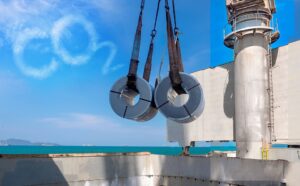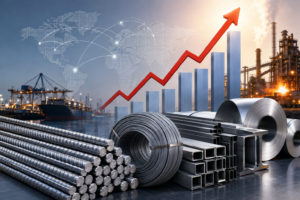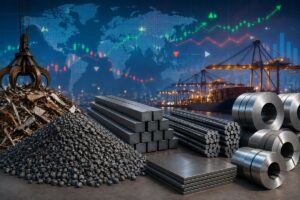


The green steel industry in Europe is currently experiencing a setback, as many manufacturers have abandoned plans to operate their production lines with renewable energy sources, such as green hydrogen, due to high costs.
European efforts are consolidating to make tangible progress in low-carbon steel production, in line with an international trend to reduce emissions and achieve carbon neutrality goals by the middle of this century (2050).
However, challenges facing the transition to green steel production in Europe remain stumbling blocks to achieving this ambition, including high electricity prices and the lack of infrastructure for clean hydrogen production and related logistics.
In the face of these challenges, Morocco, with its abundant renewable energy sources such as solar power, emerges as a promising player that could seize the continent’s market share in the production of this strategic metal using clean technologies.
Green steel typically refers to steel produced using clean electricity, a metaphor for “grey steel,” which is produced using electricity generated from fossil fuels, such as coal and natural gas.
Efforts Under Threat
Efforts to decarbonize the European steel industry suffered a fresh blow last week after ArcelorMittal, the world’s largest steelmaker, rejected public support worth more than €1 billion ($1.17 billion) to convert its German plants to run on green hydrogen.
ArcelorMittal blamed the high cost of electricity, while Swedish steelmaker SSAB announced the postponement of the start-up of its low-emission steel plant in northern Sweden, citing issues with the reliability of the electricity grid.
Electricity costs are among the challenges faced by steelmakers transitioning to green steel to reduce their high emissions.
The list of challenges also includes the need for billions of dollars in capital, a lack of hydrogen infrastructure, and weak demand for more expensive low-carbon products.
“The state of the green steel sector in Europe is not good,” said Axel Eggert, president of the European steel industry association Eurofer.
Egert added that while some are “hoping and betting” on a bright future for the green steel industry, others say, “We don’t have time for this.”
Some executives privately acknowledge that they must continue with projects regardless of cost, based on prior commitments.
Mary Garoni, transformation director at German steelmaker Thyssenkrupp, told the Financial Times at an event this week that her company is committed to its plans for green steel in Europe, despite the industry’s crisis, which is making even important investment decisions difficult.
An Environmentally Polluting Industry
The steel industry is of paramount importance to Europe, accounting for approximately 7% of global production, generating revenues of nearly €191 billion (US$224 billion) and employing more than 300,000 people directly.
However, the steel industry is also one of the continent’s largest carbon emitters. According to figures reviewed by the Energy Platform, steel plants in the European Union emit 200 million tons of carbon dioxide annually.
This figure exceeds the total annual emissions of the Netherlands and is equivalent to about 5% of the total emissions of the 28 EU countries.
Under the European Union’s 20-year-old emissions trading system, steel producers are required to purchase permits to cover their carbon emissions, which raises prices and theoretically discourages the production of green steel.
However, company executives said they have been under severe pressure from cheaper and more carbon-intensive imports, particularly from China.
According to data from the European Commission, the executive arm of the European Union, the steel production surplus last year—resulting from increased Chinese production and declining demand—was more than four times the EU’s annual steel production.
Decarbonizing the steel production sector involves either converting facilities to hydrogen or electrifying the process to eliminate the need for coal.
Electric Furnaces
Nearly 40% of steel in the EU is produced in electric furnaces, but less than 1% is produced using green hydrogen furnaces, most of which are in the pilot phase.
The EU wants the steel industry to reduce its emissions by at least 30% by 2030, compared to 2018.
Reducing electricity use is crucial to achieving this goal. Electricity accounts for about 17% of steel production costs in Europe, according to European Commission figures.
Unfortunately for the continent, electricity prices in the EU are twice those in the United States. This is squeezing profit margins for electric furnace operators.
Of the $1.6 trillion in announced global clean industrial projects, such as green steel and ammonia plants, only 10% are located in the European Union, according to a report released this month by the non-profit Mission Impossible Partnership.
Morocco is Ready
Industry experts have warned that the challenges facing green steel production in Europe could open the way for other players, such as Morocco, to enter the European market.
Lord Adair-Turner, Chair of the Energy Transitions Commission—a global alliance of businesses, investors, NGOs, and experts—said that these challenges could cause Europe to lose its capacity to produce key types of steel to countries like Morocco, which has the potential to generate abundant solar energy.
Morocco has approved $32.5 billion in green hydrogen projects focusing on the production of green steel, ammonia, and synthetic fuels, according to a previous statement issued by the Moroccan government on March 6.
attaqa