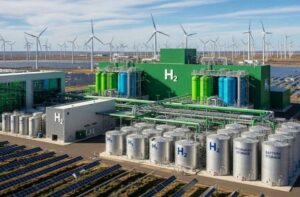



Developers of green hydrogen projects around the world have begun scaling back investments and cancelling several projects, as high production costs and weak demand for this low-carbon fuel have rendered many initiatives economically unfeasible.
Europe
- In June, energy company LEAG announced an indefinite postponement of its plans to build one of Europe’s largest green energy hubs on the site of a decommissioned coal-fired power plant in eastern Germany.
- ArcelorMittal (MT.LU) delayed its €2.5 billion plan to convert two German plants to green hydrogen in June, despite a government offer of €1.3 billion in support.
- Iberdrola (IBE.MC), Europe’s largest utility, reduced its green hydrogen ambitions by about two-thirds in March 2024 due to financing delays. Its 2030 production target was cut from 350,000 tons to around 120,000 tons per year.
- Spanish company Repsol (REP.MC) lowered its 2030 green hydrogen target by up to 63% in February, aiming for 0.7 to 1.2 gigawatts of electrolyzer capacity by the end of the decade. CEO Josu Jon Imaz cited the industry’s high costs and reliance on subsidies.
- In April, BP (BP.L) shut down its team focused on hydrogen and liquefied natural gas (LNG) for transport.
- Shell (SHEL.L) cancelled plans for a low-carbon hydrogen plant on Norway’s west coast due to a lack of demand, just days after Equinor (EQNR.OL) scrapped a similar project in the country.
- In October, Finnish refiner Neste (NESTE.HE) withdrew from a renewable hydrogen project at its Porvoo plant, citing challenging market conditions.
Australia
- In October, Origin Energy (ORG.AX) announced plans to exit a potential hydrogen project at the Hunter Valley Hydrogen Hub in New South Wales.
- In March, global commodities trader Trafigura (TRAFGF.UL) abandoned its A$750 million (US$491.5 million) plan to build a green hydrogen plant at its lead smelter in Port Pirie, South Australia.
- Last July, billionaire Andrew Forrest scaled back his company Fortescue’s (FMG.AX) goal to produce 15 million metric tons of green hydrogen by 2030, citing costs and the vast renewable energy resources required.
- Woodside Energy (WDS.AX), Australia’s largest independent oil and gas producer, halted two green hydrogen projects in Australia and New Zealand in September.
- This year, Queensland’s state government withdrew funding for a A$12.5 billion plant designed to produce 200 tons of liquefied hydrogen by 2028. Soon after, Japanese investors Kansai Electric (9503.T) and Iwatani (8088.T) pulled out.
United States
- In September, U.S. startup Hy Stor Energy canceled its booking for more than 1 GW of electrolyzer capacity from Norwegian manufacturer NEL (NEL.OL).
- In February, Air Products said it was reconsidering its plans to build a 35 tons/day green hydrogen plant in Massena, New York, due to regulatory developments disqualifying the current hydroelectric supply from clean hydrogen tax credits.
Asia
- In December, Japan’s Kawasaki Heavy Industries (7012.T) withdrew from a coal-to-hydrogen project in Latrobe, citing time and cost pressures.