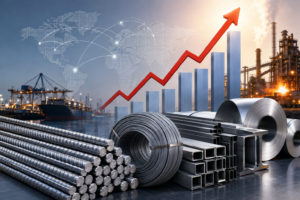




In a world where trade tariffs are rapidly escalating, it’s not only steel that’s melting — but also the delicate balance of global economies and trade alliances. The metal that once built cities, bridges, and empires has once again found itself at the center of a fierce new battle among the world’s largest economies.
Global Production
Global steel production rose by 0.3% year-on-year to 145.3 million tons in August, while output for the first eight months of this year declined by 1.7% to 1.23 billion tons.
China Leads the Way
China continues to dominate the global market, producing over one billion tons last year and accounting for 55% of global steel output from the beginning of this year through the end of August.
Top 10 steel-producing countries
| Country | Aug 2025 (Mt) | % change Aug 25/24 | Jan-Aug 2025 (Mt) | % change Jan-Aug 25/24 |
| China | 77.4 | -0.7 | 671.8 | -2.8 |
| India | 14.1 | 13.2 | 108.9 | 10.2 |
| United States | 7.2 | 3.2 | 54.6 | 1.6 |
| Japan | 6.6 | -3.4 | 54.1 | -4.5 |
| Russia | 5.5 | -4.6 | 46.1 | -4.8 |
| South Korea | 5.2 | -6.1 | 41.1 | -3.5 |
| Türkiye | 3.4 | 7.9 | 24.9 | 0.2 |
| Germany | 2.6 | -10.5 | 22.4 | -11.9 |
| Brazil | 2.9 | -4.6 | 22.2 | -1.5 |
| Iran | 1.6 | 17.9 | 19.8 | -3.6 |
Chinese Dominance
China’s massive industrial expansion has upended competitive dynamics, flooding global markets with low-cost steel products in volumes far exceeding global demand. This oversupply has driven many economies to adopt protectionist trade policies, imposing tariffs on steel imports to shield their domestic industries.
European Crisis
The European Commission has doubled import tariffs on steel to 50%, while cutting duty-free import quotas by 47% to 18.3 million tons per year, in an effort to protect the European steel industry — which is operating well below capacity.
Industry Response
Many European steel associations and producers welcomed the move, calling it a major step toward protecting a sector that employs around 300,000 people directly, despite losing nearly 100,000 jobs over the past fifteen years.
Trump’s Pressure
The European move came as a direct response to U.S. pressure, after the Trump administration imposed similar 50% tariffs on imported steel. In June, former President Donald Trump stated that the tariffs would “protect the domestic industry, making it stronger than ever before.”
Other Nations Join In
It’s not just the U.S. and the EU — Canada is now engaged in a WTO dispute with China after imposing 25% tariffs on Chinese steel products, justifying the move as necessary to protect its domestic industry from cheap imports.
A Fragile Balance
Ultimately, China’s steel abundance has proven to be a double-edged sword: on one hand, it has fueled industrial growth worldwide with affordable raw materials; on the other, it has prompted major economies to raise trade barriers in defense of their local markets.