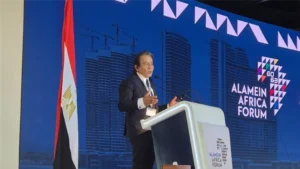


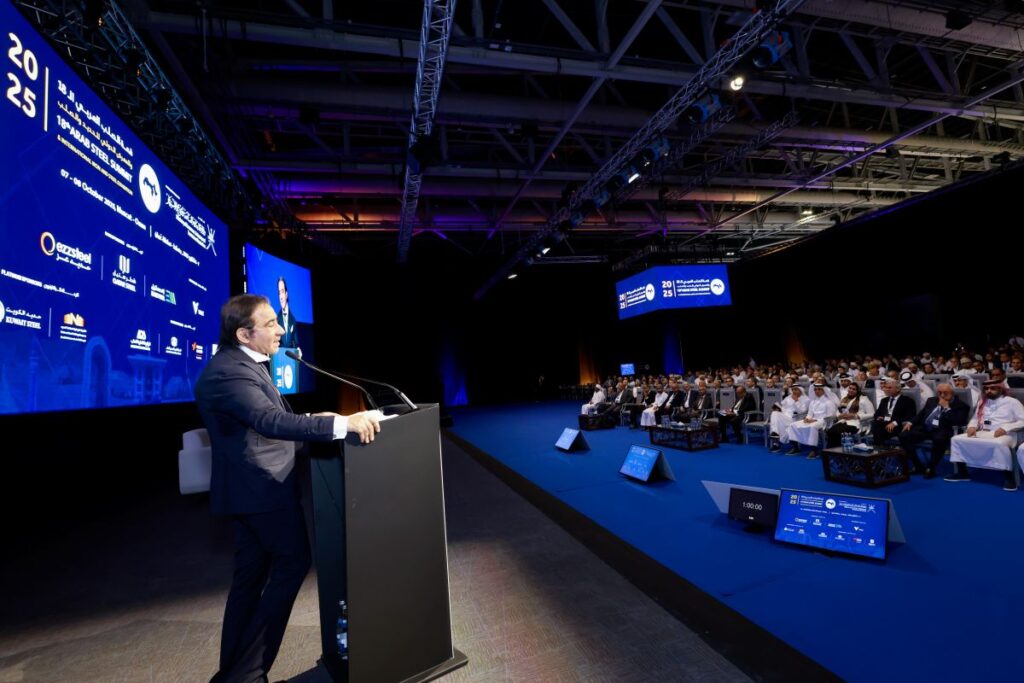
Eng. Ahmed Ezz, Chairman of the Arab Iron and Steel Union, emphasized that stimulating local demand for steel products in Arab countries begins with industrial growth, streamlining permit procedures, and facilitating land allocation for investors. He underscored the importance of empowering the private sector and supporting construction and infrastructure projects to ensure the industry’s sustainability and competitiveness.
In his opening address at the 18th Arab Iron and Steel Summit in Muscat (2025), Ezz stated that the Arab steel industry represents a main pillar of growth and development, a major source of employment, and a driver of capacity building. He highlighted the pivotal role played by the Union — which has represented Arab steel companies for over half a century — in helping the sector seize emerging opportunities and overcome challenges.
Ezz pointed out several positive indicators: the Arab world is a leading producer of steel, its population continues to grow steadily, and this expansion provides strong prospects for rising steel demand, with the region now nearing 60 million consumers of steel products.
He added that Arab GDP continues to increase steadily, and that many Arab countries possess the resources and capabilities required for industrial success and sustainable growth.
The Chairman of the Arab Iron and Steel Union emphasized that while growth prospects are promising, they depend on overcoming several key challenges. These include low per capita steel consumption in Arab countries compared to Western Europe, limited production of coils and flat steel products—the backbone of modern steelmaking—and declining export prices, which have reduced profitability relative to less complex industries that require far lower capital investment.
Ezz reflected on his decades-long experience, noting: “When I began working in the steel industry in the early 1980s, global production was about 600 million tons. Today, the same amount represents the current global surplus capacity. This surplus doesn’t come from China alone, but also from other regions, and much of it is being redirected to export markets.”
He called for prudent management of global overcapacity, taking into account the development stage of each country. He noted that nations such as Japan, South Korea, and Turkey are seeing declining populations but rising steel production, which disrupts the global balance. “We must deal with global resources more rationally,” he stressed.
Ezz also warned of the rise of protectionist trends in global trade, particularly in the steel industry. He said that international trade rules are nearing collapse amid widespread protectionism, and that there is now an alliance between the U.S. and the EU to coordinate protectionist measures and impose more trade restrictions on smaller economies.
He pointed out that the U.S. President launched a $700 billion support plan for the domestic automotive sector, while simultaneously subjecting dozens of foreign companies to anti-dumping and subsidy investigations without legitimate grounds, accusing them—without evidence—of links with China to justify these restrictions.
Ezz stressed the importance of careful review of bilateral trade agreements, calling on governments to seek expert advice to avoid signing binding deals that conflict with their trade and development interests.
He also highlighted several structural challenges facing Arab steel companies, particularly those affecting cost structures. For example, OPEC’s new ambiguous tender-based pricing system has complicated input costs for energy-intensive industries like steel.
Ezz called for a better balance between centrally planned government projects and private-sector initiatives, especially in construction, licensing, and business establishment. He emphasized the need for strategic planning to boost steel consumption through supporting industries such as automotive manufacturing, home appliances, and shipbuilding, suggesting the creation of joint public-private initiatives to advance this goal.
Concluding his remarks, Ezz affirmed: “Opportunities in the Arab region lie ahead, not behind us. The groundwork is set for significant progress and success in the future. We must continue to invest in upstream industries and improve the specifications of Arab steel products to overcome rising protectionism and trade barriers.”
Al-Shorouk Newspaper