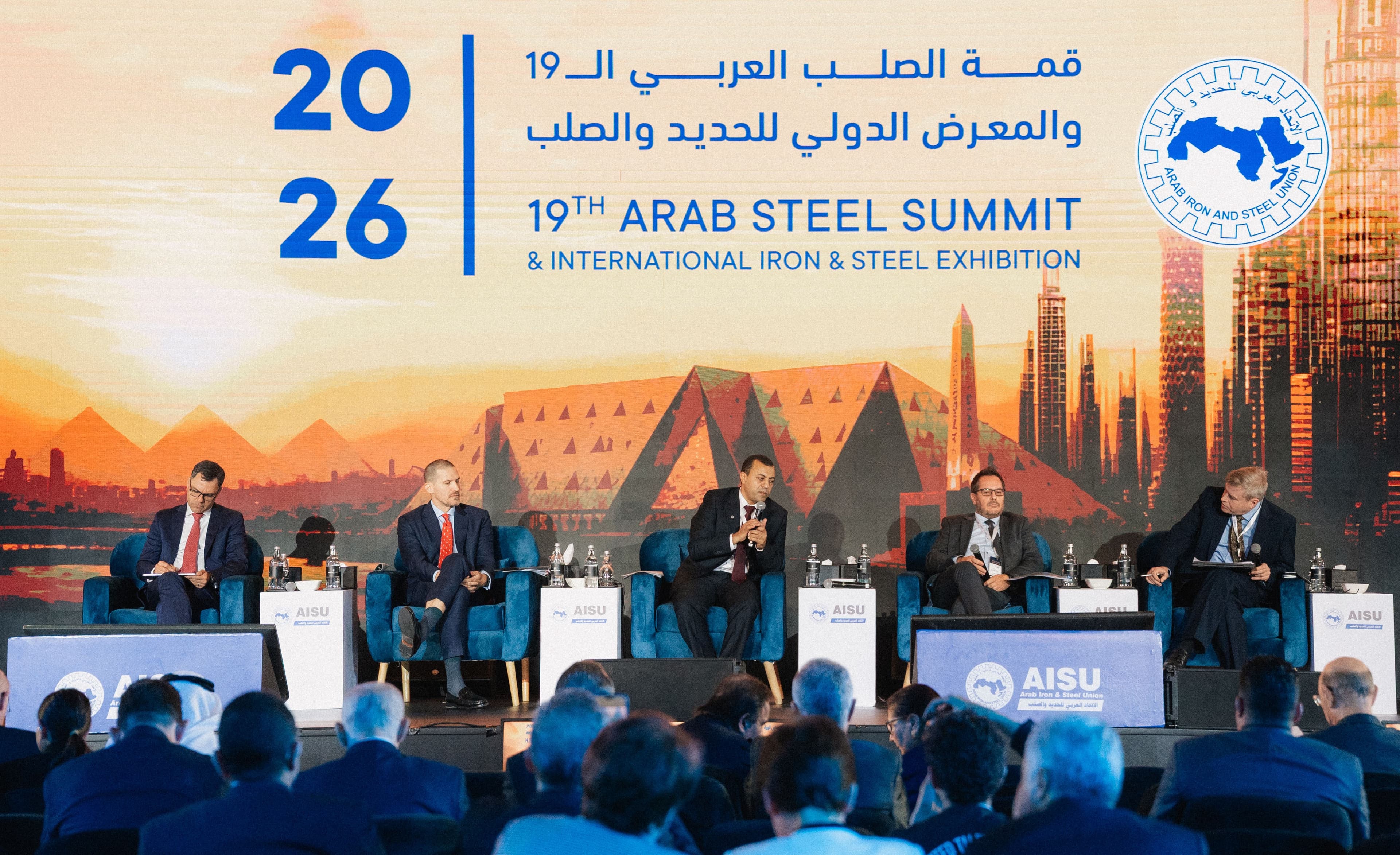
The seventh session, during the second day of the 19th Arab Steel Summit, discussed the challenges of decarbonization in the Arab steel industry, the repercussions of the European Carbon Border Adjustment Mechanism (CBAM), opportunities for reducing compliance costs and enhancing the competitiveness of Arab exports, alongside available technologies for reducing emissions and transitioning to low-carbon production.
Participants in the session included Mohamed Imam Omar, Head of Steel Industry Management for Electric Arc Furnaces at Qatar Steel; Dimitrios Dimitriou, Executive Vice President and Chief Sales Officer at Emsteel; Paolo Carvalho, Managing Director of Decarbon Value; and Andreas Rathhuber, Managing Director of Primetals Technologies. The session was moderated by Andrew Purvis, Head of Sustainable Manufacturing at the World Steel Association.
Mohamed Imam Omar, Head of Steel Industry Management for Electric Arc Furnaces at Qatar Steel: 20% of global Direct Reduced Iron production comes from the Arab region
Mohamed Imam Omar affirmed that the Arab steel industry's reliance on electric arc furnaces and natural gas-based direct reduced iron gives it an advantage in facing the requirements of the European Carbon Border Adjustment Mechanism (CBAM), noting that this production structure provides Arab producers with a strong starting point for dealing with the mechanism, provided that emissions measurement and verification systems are developed, and products directed to foreign markets are diversified.
Omar explained that the Carbon Border Adjustment Mechanism currently targets six sectors with high exposure, and iron and steel are at the core of the European Union's strategic import policy. The mechanism obliges imports to bear a carbon price equivalent to the price imposed on production within the EU, thereby maintaining a level playing field between local producers and importers.
He pointed out a fundamental difference between the requirements of CBAM and the Greenhouse Gas (GHG) Protocol, explaining that traditional carbon footprint reports for companies are insufficient for compliance with the European mechanism; CBAM requires a legally binding declaration at the product level, measuring emissions in tons of CO2 per ton of product, whereas the GHG Protocol relies on aggregating emissions within Scopes 1, 2, and 3.
He added that the mechanism focuses on actual manufacturing facilities and upstream raw materials used in product manufacturing, and does not allow the use of carbon offsets to reduce declared emissions. He clarified that upstream raw materials are products subject to the mechanism that are used in the manufacturing of another product subject to it. Therefore, embedded emissions in inputs such as iron ore and billets are directly included in the emissions calculation associated with the final steel product, while iron scrap is calculated with embedded emissions equal to zero.
He stressed the importance of tracking emissions across the supply chain to ensure the availability of necessary data for calculating the final product's carbon footprint.
He addressed the method of calculating financial obligations under the mechanism, explaining that it is based on actual verified emissions compared to a benchmark, taking into account the free allocation factor, and then calculating the cost according to the prevailing carbon certificate price in the European Emissions Trading System (EU ETS), deducting any carbon price already paid in the country of origin.
He presented an example of a plant in the region illustrating the financial impact of providing documented emissions data, stating that the CBAM cost for a gas-based direct reduced iron product, based on verified data, amounts to approximately 22 euros per ton in 2026, whereas it could rise to 88 euros per ton if the plant fails to provide documented data and the importer is forced to use the high default values set by the EU. He clarified that the example used a low default value, and the actual cost could be higher, underscoring the economic importance of accurate verification of emissions data.
Omar outlined six essential steps for verifying CBAM emissions at the facility level, starting with defining the plant's boundaries, then preparing a precise emissions monitoring plan, tracking upstream raw material data such as iron ore and billets, conducting measurements throughout the year, engaging an EU-accredited third-party verifier, and finally, submitting reports via the CBAM registry.
He indicated that implementing these steps requires collaboration between procurement, operations, and technical and regulatory teams within the plants to ensure data is collected and reviewed regularly.
Regarding the advantages of the Arab steel industry, Omar stated that CBAM's focus on direct process emissions, while excluding electricity emissions in steel production as presented, gives the region a strong starting point, given that a significant portion of its production relies on electric arc furnaces and gas-based direct reduced iron.
He explained that 99% of Arab steel production, amounting to 43.7 million tons in 2025, was smelted using electric arc furnaces, while carbon-intensive traditional smelting furnaces represent about 1% of the total capacity, according to the data he reviewed.
He added that electric arc furnaces in the region primarily rely on gas-based direct reduced iron, noting that Arab countries produced 30.5 million tons of gas-based direct reduced iron and hot briquetted iron (HBI) during 2025, which represents 20.2% of global direct reduced iron production and 30% of global gas-based direct reduced iron production.
He pointed out that reliance on gas provides a production pathway with lower direct emissions compared to traditional coal-based smelting furnaces, and also allows for a future transition to hydrogen use. According to his presentation, the production pathway based on direct reduced iron and electric arc furnaces records about 67% lower direct emissions compared to the traditional smelting furnace pathway, citing data on the production of steel bars using direct reduced iron as an example of direct emission levels in a regional plant.
Omar then moved on to the trade challenges facing Arab producers, noting that the region exported 8.9 million tons of finished steel products in 2025, including 5.8 million tons of long products and 3.1 million tons of flat products, at a time when global markets are increasingly shifting towards flat products.
He explained that the European Union lost about 31 million tons of steel production since 2014, while traditional smelting furnaces still represent 54% of its production. To compensate for the decline in domestic production, the EU imported 37.9 million tons of flat and long steel products during 2025.
Arab plant exports to the European market amounted to approximately 2.6 million tons, according to his presentation, noting that Arab products accounted for 5.5% of the EU's flat steel imports and 10.4% of its long product imports.
He highlighted a trade structure imbalance between the two sides; flat products represent 75% of the EU's total steel imports, while 85% of Arab regional production is concentrated on long products, which limits the ability of Arab producers to fully capitalize on European demand.
Omar proposed a pathway to address CBAM requirements over three timeframes. In the short term, the priority is to eliminate reliance on default values by measuring and verifying emissions, enabling plants to provide actual data on their environmental performance. In the medium term, the priority is to leverage low-carbon raw materials and enhance the advantages associated with lower-emission production pathways. In the long term, he called for diversifying the product mix and expanding flat steel production to capitalize on the existing gap in the European market, given the reduction in free allowances allocated to producers within the EU.
Omar concluded by emphasizing that the Arab infrastructure based on natural gas and direct reduced iron represents significant commercial assets in light of the CBAM implementation, noting that the transition from mere compliance with environmental requirements to active supply chain tracking and market diversification can transform increasing environmental restrictions into a competitive advantage for Arab producers.
Demetrios Dimitriou, Vice President for Governance and Environment at MSTEEL: Emissions reduction is becoming a decisive factor in the competitiveness of the steel industry
Demetrios Dimitriou affirmed that reducing carbon emissions is no longer just an environmental or regulatory obligation, but has become an influential factor in the commercial competitiveness of the steel industry, including the ability to access regulated export markets, supply costs, customer purchasing decisions, and opportunities for green transition-related financing.
He explained that the Arab steel industry begins its emissions reduction journey from a different position than other regions, given that a significant portion of its production relies on natural gas, direct reduced iron, and electric arc furnaces, which gives it relatively lower emission levels compared to traditional coal-dependent producers.
He indicated that MSTEEL also relies on natural gas and includes three reactors and three steelmaking plants, explaining that its emissions are about 40% lower than the global average, and it has reduced Scope 1 and 2 emissions by about a third since 2019, which serves as the baseline year for measuring this reduction.
He added that possessing a production base with lower emissions is not sufficient on its own to ensure continued competitive advantage, as the strategic challenge lies in transforming this existing advantage into sustainable competitiveness, especially in regulated export markets, foremost among them the European market.
Dimitriou explained that competitiveness in the steel industry traditionally depended on the availability of raw materials, energy, logistics, production efficiency, quality, and proximity to markets, but this equation is changing with the introduction of carbon performance as an additional influential factor.
He stated that the level of emissions now affects companies' ability to access export markets, the relative cost of supplying their products, customer purchasing decisions, as well as opportunities for obtaining green and transition financing, and the long-term competitiveness of existing production assets.
He added that the European Carbon Border Adjustment Mechanism (CBAM) represents one manifestation of this shift, but the issue goes beyond the mechanism itself, given the gradual trend of customers to consider carbon performance in their purchasing decisions. Thus, emissions reduction has moved from being an environmental issue or a regulatory compliance obligation to a matter related to business strategy and capital allocation.
Regarding steel production routes, Dimitriou stressed the importance of recognizing the emissions reductions already achieved within Arab production models, which rely heavily on the direct reduced iron and electric arc furnace route.
He cited the ResponsibleSteel standard as one of the frameworks that adopts a technologically neutral approach and allows for the assessment of emissions reduction efforts through three levels, taking into account the varying rates of scrap utilization. He explained that the importance of this approach lies in recognizing emissions reduction efforts in primary steel production, rather than solely rewarding producers with larger quantities of scrap iron.
He affirmed that the CBAM enhances the incentives available to producers to reduce emissions, but cautioned against treating it as a comprehensive commercial feasibility study that alone justifies massive decarbonization investments.
He explained that there is a difference between regulatory recognition of embedded emissions in a product, achieving a commercial advantage for low-carbon steel, and ensuring a bankable return on investment for major assets, noting the need to distinguish between these aspects when making investment decisions.
The Vice President for Governance and Environment at EMSTEEL called on Arab producers to adopt a phased approach to emissions reduction, explaining that dividing the transition into stages does not mean postponing it, but rather prioritizing measures that protect current competitiveness while maintaining a reliable long-term transition path.
The first phase involves implementing currently available and economically viable measures, such as improving energy efficiency, using renewable energy or electricity when possible and feasible, alongside optimizing production processes. The second phase focuses on preserving future technological options and avoiding investments that could limit companies' ability to implement deeper emissions reductions in later stages. The third phase represents the long-term transition, through adopting deeper emissions reduction measures, such as using hydrogen or introducing changes to production processes in some cases.
Demetrio presented some of the measures the company is working on in this area, explaining that it began capturing carbon dioxide in 2016, with a capacity of 800,000, without specifying the unit of measurement in his speech.
He added that the company is seriously studying various emission reduction pathways and has the first pilot facility related to steel production in the field of hydrogen, alongside several electrolysis plants connected to its reactors. He also noted that the company is exploring the electrification of its production assets, linking circular economy aspects between steel and cement production plants, and enhancing the use of by-products to support the circular economy.
Managing Director of Decarbon Value Paolo Carvalho: Verifying emissions allows Arab steel exporters to reduce CBAM costs by up to 77% by 2035
Paolo Carvalho affirmed that the European Carbon Border Adjustment Mechanism (CBAM) presents commercial opportunities for Arab iron and steel exporters, but simultaneously imposes challenges related to compliance and emissions verification costs, and commercial risks facing European importers during the transitional phase.
He explained that the mechanism's impact should be understood in a broader context that includes escalating geopolitical tensions, increasing trade protectionism, and slowing economic growth in major steel-consuming markets, including the European market.
Carvalho pointed out that CBAM is gradually replacing the free allocation of allowances in the EU Emissions Trading System (ETS) as a mechanism to prevent carbon leakage, noting that 2030 represents a turning point, as the proportion of CBAM costs borne by European importers will reach 50% or more, whether the current law remains in effect or the European Commission's recent proposals on the phased implementation of the mechanism are applied.
Carvalho stated that the benchmark emissions values under CBAM will become more stringent concurrently with the phasing out of free allowances, explaining that they represent the maximum emission intensity limits that an exporter can adhere to without imposing additional costs on the importer under the mechanism, while emissions exceeding these levels will result in financial obligations for importers.
He added that the European Union has set different benchmark values for the steel industry according to production routes, including Direct Reduced Iron (DRI), Electric Arc Furnaces (EAF), scrap, and traditional smelting furnaces, noting that these benchmarks will decrease significantly in the coming years with the reduction of free allocations and the increasing application of CBAM.
Carvalho explained that this trend means rising mechanism costs over time when relying on default values, citing a comparison he conducted between the costs of importing direct reduced iron and pig iron from different sources, including the United States and Arab countries for direct reduced iron, and Brazil and Ukraine for pig iron.
He pointed out that, with the exception of Algeria, there are no specific CBAM default values for Arab countries, and therefore, general default values or country-specific ones are applied to them, according to the calculations he reviewed.
Carvalho pointed to a disparity in the costs associated with default values among production sources, explaining that direct reduced iron produced in the United States using natural gas, and with the same production route used in Arab countries, incurs a significantly lower CBAM cost due to the lower default values applied to it, despite the similarity in the production route and the reducing agent used.
He called for monitoring any potential updates to the default values by the European Commission in the coming period, or their review by 2028, noting that similar conclusions apply to final and semi-finished products.
Conversely, Carvalho explained that using actual emissions data leads to a significant reduction in CBAM costs, although differences remain depending on the product type. He indicated that Arab iron and steel exporters could reduce these costs by up to 77% by 2035, if a set of basic assumptions are met, by relying on verified actual emissions data.
He clarified that the charts he presented compare the costs of relying on default values with those resulting from the use of actual emissions, with red lines allocated to direct reduced iron exports from Arab countries.
Carvalho pointed out that one of the factors that does not receive sufficient attention in trade negotiations related to CBAM is that the risks facing European importers are likely to increase in the coming months, before starting to decline from 2028 onwards.
He explained that these risks are linked to three main factors. The first is the uncertainty regarding suppliers' ability to provide verified actual emissions data, as this situation will continue for at least the first half of next year and will only begin to subside with the emergence of the first emissions data approved by verification companies, expected to start in the second half of the year, or earlier for pioneering companies.
The second factor is the quarterly retention requirements for CBAM certificates, which amount to 50% of the expected cost of the mechanism for each import transaction, and apply to imports from January 2027. He explained that these requirements necessitate providing funds long before the actual CBAM costs are paid, thereby putting pressure on importers' cash flows and working capital.
The third factor relates to the use of default values when calculating quarterly retention requirements; they must be used during 2027, whereas this will not be required in 2028.
He said that the convergence of these three factors increases the level of risk for importers in the short term, before it begins to decline from 2028 onwards. He expects this to be reflected in trade negotiations between importers and suppliers in the coming months, making them more complex regarding the distribution of risks and costs, and possibly price premiums.
Regarding the main risks of the mechanism, Carvalho indicated that they include compliance and emissions verification, market risks, and the uncertainty surrounding trade negotiations, in addition to potential differences in emissions calculation methodologies, emphasizing that the verifier's opinion is the decisive factor in the end.
Conversely, he identified three main opportunities for Arab iron and steel exporters. The first is to help European customers avoid CBAM costs, explaining that natural gas-based hot briquetted iron (HBI) products allow European importers significant cost reductions when submitting verified emissions data, compared to relying on default values. He also pointed to the possibility of benefiting from not being subject to quotas applied to rebar and billet.
The second opportunity lies in bridging the gap in the European market's metal supply, which arose from the ban on direct reduced iron and hot briquetted iron imports from Russia, coinciding with signs of recovery in European domestic production. He stated that direct reduced iron and hot briquetted iron, which rely on natural gas in Arab countries, are well-positioned to capitalize on this gap.
The third opportunity relates to the potential for changing the mix of raw materials used in steel production, by increasing the use of scrap in the production of direct reduced iron and long electric arc furnace products, such as rebar. This would allow a portion of domestic direct reduced iron and hot briquetted iron production to be directed towards export, benefiting from the absence of quotas and lower CBAM costs.
Carvalho concluded by noting the existence of additional factors that could enhance the commercial value of Arab products. These include the emergence of low-carbon product labels in Europe, associated regulatory developments, requirements for increased data transparency across value chains, alongside sustainability considerations and other market developments.
Andreas Rathhuber, Executive Vice President and Global Chief Sales & Marketing Officer at Primetals Technologies: The Arab steel industry has a competitive advantage in reducing emissions by approximately 47%.
Andreas Rathhuber reviewed the technological transformation pathways towards low-emission steel production, emphasizing that the Arab steel industry possesses an advanced starting point compared to many regions worldwide, thanks to the adoption of natural gas-based direct reduction technology and electric arc furnaces by a number of producers.
He explained that the combination of natural gas-based direct reduction and the electric steelmaking industry has already contributed to significant reductions in carbon dioxide emissions, reaching approximately 47% compared to the traditional production route relying on blast furnaces. He pointed out that this figure represents a significant competitive advantage for the Arab steel industry, which can build on its current expertise in direct reduction technology by improving the efficiency of existing production assets and preparing to increase reliance on hydrogen as it becomes available.
Rathgeber indicated broad consensus within the steel industry on three main pathways to achieve net-zero emissions. The first involves production electrification, through the expansion of highly efficient electricity-based processes, primarily electric arc furnaces, while relying on renewable energy and advanced process control systems.
The second pathway involves directly avoiding carbon emissions by replacing fossil fuel-based reduction processes with hydrogen, in parallel with developing the necessary infrastructure and hydrogen supply ecosystem to support large-scale iron production.
The third pathway involves carbon capture, utilization, and storage technologies, which are gaining particular importance for existing facilities with long operational lifespans that cannot be immediately or economically replaced.
He added that digitalization and artificial intelligence represent a fourth, not-to-be-underestimated enabling factor, as digital solutions can improve productivity, raw material yield rates, and energy consumption, in addition to reducing emissions at a faster pace compared to many other technological investments.
In his review of available technologies, Rathgeber pointed to the Midrex Flex technology, which allows direct reduction plants to start up using natural gas and then gradually increase the proportion of hydrogen as its availability improves.
He explained that the hydrogen used can be produced on-site or obtained through pipelines, whether it is green hydrogen or from other available sources. He noted that the technology is ready for 100% hydrogen use, but the real challenge lies in the availability of sufficient renewable energy and the necessary infrastructure for producing and transporting hydrogen at economically viable costs.
Rathoeber discussed the role of carbon capture technologies in reducing emissions, especially in regions with long-operational production facilities, while natural gas remains available at a competitive cost.
He explained that these technologies allow producers to achieve rapid emission reductions without needing to replace existing facilities, pointing to two pathways for carbon dioxide capture: the first from blast furnace gas, and the second from flue gases. He added that the captured carbon dioxide can be stored or used in chemical industries or in the oil and gas sector.
Regarding raw material challenges, he explained that the shift of more global projects towards direct reduced iron production increases the importance of ensuring the availability of suitable iron ores. This has prompted Primetals Technologies and its partners to develop new technologies, contributing to the reduction of total required investments. These can also be operated with natural gas until hydrogen becomes available.
In conclusion, Rathoeber reviewed a number of ongoing transformation projects in Europe, noting investments by Salzgitter and Dillinger in Germany, Voestalpine in Austria, and U. S. Steel in Slovakia, reflecting the transition of low-emission steel production from the theoretical planning stage to actual implementation.
He pointed out that an important aspect of these projects is the focus on technological flexibility, whether by enabling a gradual transition to hydrogen use or the ability to handle different raw material blends in charging processes.
He emphasized that maintaining this flexibility and offering multiple operational options are particularly important given the uncertainty surrounding the availability and cost of energy and hydrogen sources. He noted that this approach represents an option that Arab steel producers should consider when planning their future investments.