
The Simandou project may add 116 ships to the global demand for iron ore carriers
Rahul Sharan: Geopolitics is the most dangerous threat to the dry bulk shipping market, and shipping costs are pressuring iron and steel producers
Drewry: Uncertainty about ships transiting the Strait of Hormuz is more dangerous for importers than rising shipping costs
Inventories do not protect factories from long-term disruptions, and chartering ships directly requires different expertise
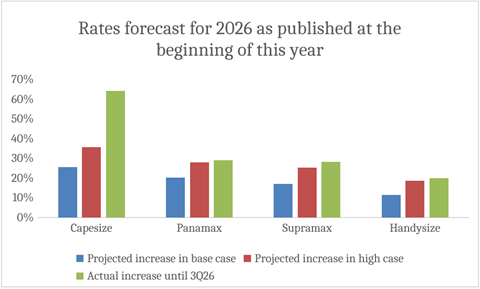
Panamax vessel charter rates have risen 29% this year compared to a baseline forecast of 17%, and the geopolitical crisis is the reason
The cost of producing iron and steel is no longer solely linked to raw material and energy prices; maritime shipping costs have become one of the main factors affecting producers' competitiveness. This is gaining increasing importance in light of global trade disruptions, geopolitical tensions, and rising fuel prices, which have pushed shipping costs to levels that pressure the profit margins of mining and steel companies, and raise questions about the feasibility of production, supply sources, and the distances between production areas and consumer markets.
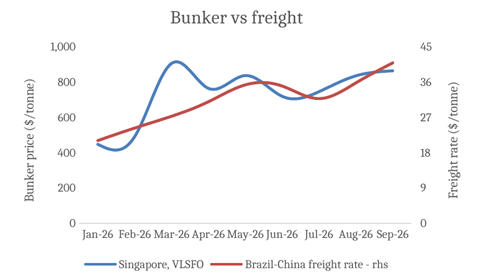
The figures reveal the extent of these pressures; the cost of shipping iron ore on the route connecting the Brazilian port of Tubarão to the Chinese port of Qingdao rose to $38.36 per ton in early September 2026, a 57% increase year-on-year, and nearly double compared to about $20 per ton in January of the same year, according to data from the maritime brokerage firm Banchero Costa. In another indicator of escalating pressures, the shipping cost on the Brazil-China route rose from $22–23 per ton before the outbreak of the war in the Middle East in late February 2026 to $42.12 on September 14,
The share of transportation costs in the market value of raw materials reflects the burden faced by mining companies. Brazilian newspaper O Fator quoted industry executives saying that maritime shipping costs now account for about 40% of the price of a ton of iron ore, which hovers around $100, increasing the impact of fluctuations in the maritime transport market on producers' profit margins and the economic viability of exports.
These pressures are no longer just an additional burden on mining companies; they have already impacted production decisions. In September 2026, the Brazilian company Mineração Usiminas indefinitely suspended operations at its Samambaia mine in Minas Gerais, a move the company attributed to falling iron ore prices and rising maritime shipping costs. The mine represents about 30% of the company's mining production capacity of 9 million tons per year. Itaminas also announced the temporary suspension of one of its iron ore processing units during October and granted leave to about a third of its employees, measures that Brazilian reports linked to rising maritime shipping costs and aimed at preserving liquidity.
In light of these developments, questions arise about the future of the dry bulk shipping market, the impact of maritime route disruptions, fuel prices, and vessel availability on raw material trade, as well as potential shifts in the global supply map with the entry of new mining projects into the market and changes in production and consumption centers, and the opportunities and challenges these shifts present to the Arab iron and steel industry.
To explore these shifts, we conducted this interview with Rahul Sharan, Head of Research at Drewry, responsible for the company's research and publications related to dry bulk, oil tankers, and gas shipping, to discuss maritime transport market trends, the evolution of shipping costs and the factors influencing them, their impact on iron ore and coal trade and the steel industry, as well as the future of the global trade map and the opportunities available to Arab producers.
Sharan holds a Master's degree in International Economics from the University of Namur in Belgium and a postgraduate degree in Economics from Jawaharlal Nehru University in New Delhi.
Sharan revealed to "Arab Steel Bulletin" through Drewry data that the dry bulk shipping market entered 2026 with stronger-than-expected momentum, especially in the Capesize vessel segment. At the same time, the price of VLSFO bunker fuel in Singapore and the freight rate on the Brazil-China route increased by about 93% between January and September. Iron ore remained the largest component of large vessel shipments, while new shipbuilding orders reveal a greater trend towards alternative fuels. In this dialogue, Rahul Sharan from Drewry explains how these shifts interact with the disruption of shipping routes, geopolitical risks, and environmental pressures, and what they mean for shipping costs and the competitiveness of the steel industry.
First Focus: The Dry Bulk Shipping Market and Global Trade Shifts
You predicted a moderate improvement in the dry bulk shipping market during 2026. In light of the developments seen this year so far, to what extent has the market's actual performance aligned with your expectations? And what factors have led to outcomes that differed from your original forecasts?
The report was published at the beginning of the first quarter of 2026, when we expected a significant increase in vessel charter rates across different segments, according to the base case and the high case scenarios. However, rates rose much higher than we expected in the base case scenario (up to the third quarter of 2026).
For example, in the base case scenario, we expected the average one-year time charter rate for a Panamax vessel with a deadweight capacity of 74,000 tons to increase by 17% in 2026 compared to 2025. In the high case scenario, we expected an increase of 28%. The actual increase recorded so far this year has been 29%. Therefore, our expectations were very close to the high case scenario. The main difference compared to the base case scenario lies in geopolitical factors, which are always difficult to predict. Prices rose significantly during the crisis, creating a higher market base level. The increase in Capesize vessel rates was even greater.
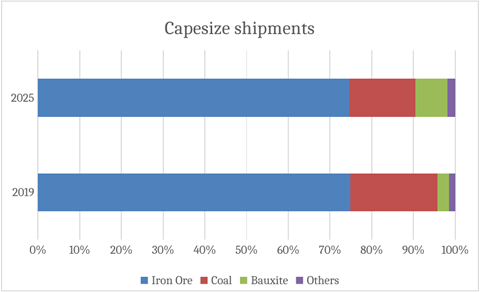
According to DrewryAIS, Capesize vessel cargo flows have also seen shifts in recent years, with a clear change in the cargo mix. Iron ore remains dominant, but the share of coal has declined, while bauxite has rapidly risen to become an important commodity in long-haul trade. This shift has narrowed the availability of Capesize vessels, with more cargoes competing for the same fleet, which has supported earnings and boosted their price premium compared to smaller vessels.
Glossary of Terms
Time Charter (TC) rate: The payment a charterer makes for the use of a vessel for a specified period.
1-year TC rate: The time charter rate for one year; the average daily freight rate agreed for the use of the vessel for a full year.
Deadweight (DWT/dwt): A measure of the total weight a ship can carry.
Base case/High case: Base case/High case; two estimates used to present the expected outcome under normal and more optimistic conditions.
Capesize vessels: A class of large bulk carriers, primarily used for transporting iron ore, coal, and bauxite, and typically unable to transit the Panama Canal due to their size.
Infographic 1: Vessel Charter Rate Forecasts for 2026 vs. Actual Increase as of Q3.
Source: Drewry Maritime Research
You mentioned the potential impact of changing shipping routes on the dry bulk market. How could the resumption of navigation through the Suez Canal, with its shorter voyages compared to longer alternative routes, affect available vessel capacity and freight rates? And what conditions are necessary for this to cause a tangible change in the market?
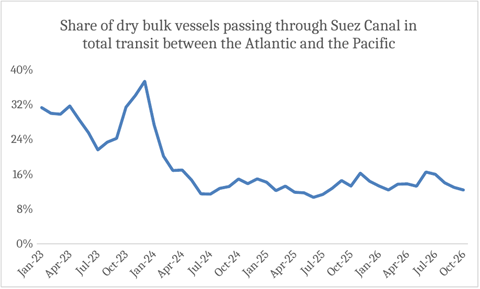
The shift from sailing around the Cape of Good Hope back to using the Suez Canal has not yet occurred. Recent attacks in the region have not helped this, as shown in the chart below based on DrewryAIS data.
If the share of ships transiting the Suez Canal increases, sailing distances will decrease, freeing up some fleet capacity and putting downward pressure on charter rates. The same number of ships will be able to complete more voyages because they will travel shorter distances, meaning fewer ships will be needed to transport the same quantity of goods. Consequently, effective supply will increase even if the total number of ships in the fleet remains unchanged.
Glossary of terms and expressions
Suez Canal: A shipping lane between the Red Sea and the Mediterranean Sea
Cape of Good Hope: The alternative sea route around the southern tip of Africa
Charter rates: The payment made for the use of a ship
Effective vessel supply: The available capacity for carrying cargoes, influenced by the number of voyages ships can complete.
Infographic 2: Share of bulk carrier ships transiting the Suez Canal out of total transits between the Atlantic and the Pacific.
Source: DrewryAIS
Drewry data shows a change in the cargo mix carried by Capesize vessels; the share of bauxite increased from about 3% in 2019 to 8% in 2025, while the share of coal decreased from 21% to 16%. Iron ore remained at about 75% of total cargo volumes. How does this change in cargo mix affect vessel deployment on trade routes? And could it also affect vessel availability for iron ore cargoes and the cost of transporting ore?
By a change in cargo mix, we mean that more Capesize vessels are carrying bauxite, while fewer vessels are carrying coal. Most of the bauxite carried by Capesize vessels is shipped from Guinea. As a result, more vessels are currently operating on the Guinea–China route, with some shifting away from routes such as Australia–China and Indonesia–China/India.
This means more Capesize vessels are operating on longer routes, which is one reason why their charter rates have increased more than those of smaller vessels. The shift we have seen has been mostly from coal to bauxite, while the share of iron ore has remained relatively stable.
Cargo mix: The distribution of types of cargo carried by vessels
Bauxite: The primary ore used in aluminum production
Vessel deployment: The allocation of vessels to specific routes or markets
Guinea–China route: A route for transporting bauxite or iron ore from Guinea to China, depending on the type of cargo.
Infographic 3: Comparison of cargo mix transported on Capesize vessels between 2019 and 2025.
Source: DrewryAIS
Second Pillar: Shipping Costs and Steel Industry Economics
In March 2026, you reported that benchmark prices for very low sulfur fuel oil (VLSFO) in Singapore had risen by more than 100% compared to the February average, while freight rates on the Brazil-China iron ore route (C3) increased by about 24%. For a Capesize vessel carrying 170,000 tons of iron ore and not using an exhaust gas cleaning system, the fuel cost increased to more than 85% of the total shipping cost. How has this jump reshaped the cost structure of the voyage? And to what extent can shipowners pass on higher fuel costs to charterers instead of absorbing them through reduced profit margins?
The direct impact of rising ship fuel prices this year has been an increase in voyage costs. When a ship is chartered under a time charter and operated by a time charterer, the charterer bears the fuel cost instead of the shipowner. The owner continues to receive the agreed daily charter hire, while the charterer bears the fuel cost and receives freight revenue from cargo transportation. Therefore, the direct impact of higher fuel prices falls on the voyage economics for the charterer.
If the shipowner operates the ship directly in the spot market on a voyage basis, they bear the higher fuel costs, and their ability to recover them by raising freight rates depends on market conditions.
The graph below compares the increase in ship fuel prices with the corresponding increase in freight rates on the C3 route.
Very low sulfur fuel oil (VLSFO): A type of ship fuel
Bunker price/cost: The cost of fuel used for the voyage
Period/time charter: Chartering a vessel for an agreed period
Time charterer: The party that charters the vessel and typically bears the fuel cost in this type of contract
Brazil–China iron ore freight index (C3): An index of iron ore freight rates between Brazil and China, used to track voyage costs on this route.
Infographic 4: Evolution of Singapore bunker prices and Brazil–China iron ore freight rates during 2026.
Source: Drewry Maritime Research
In September 2026, Brazil’s Mineração Usiminas suspended operations at its Samambaia mine indefinitely, amid falling iron ore prices and rising maritime freight costs. According to reports, freight rates on the Brazil–China route increased from around $22–23 per tonne to $37–38 per tonne. To what extent can rising freight costs undermine the economic viability of iron ore exports, even with continued demand in importing markets? What factors determine the point at which cutting production becomes less costly than continuing operations?
The impact becomes more pronounced when iron ore is imported from longer distances, as higher freight costs reduce the economic viability of transporting ore to the consumer market. This is one reason why China is seeking to diversify its iron ore sources, including Guinea and, more recently, the Kribi–Central African Republic corridor. Strategic diversification of supply sources is another important factor.
Freight costs/rates: The cost of transporting ore by sea
Economics of transport: The extent to which transport remains viable after accounting for its cost
Diversification of supply: Spreading purchases across more than one source
Kribi–Central African Republic corridor: A supply corridor mentioned as one of the options China is pursuing.
6. Can a sustained increase in maritime freight costs reshape the competitive landscape among iron ore suppliers, weakening the position of producers located further from Asian markets even when their ore prices remain attractive? How do Brazil, Australia, and Guinea differ in terms of how shipping distances and voyage costs affect their ability to supply iron ore to China?
Answer: China does not have many alternatives capable of supplying the volume of iron ore it requires. Guinean iron ore will take another three to four years before reaching its targeted capacity of around 100–120 million tonnes per year, while the Kribi–Central African Republic corridor will take even longer to commence operations. China will therefore continue to rely heavily on Brazil and Australia to meet its iron ore needs, at least for the next few years.
Targeted capacity: The volume of production or supply that is planned to be achieved
Sourcing: Selecting the countries or producers from which raw materials are purchased
Iron ore: The primary raw material for iron production
Voyage costs: Maritime transport costs associated with distance and the journey.
Given the sharp fluctuations in freight rates and the risk of shipment delays, what are the most effective tools for steel companies and raw material importers to manage shipping risks: long-term contracts, diversification of supply sources, increasing inventories, or chartering vessels directly? How should companies balance the costs of these strategies against the risks they help mitigate?
I believe all these tools can play a role, with the possible exception of chartering vessels directly. Long-term contracts, diversification of supply sources, and maintaining adequate inventories can all help manage shipping and supply risks. Chartering vessels directly, however, moves the company into an area that requires different expertise, specialized knowledge of maritime shipping, and professional capabilities in this field.
Long-term contracts: Supply agreements that extend over a long period
Diversified sourcing: Relying on more than one source for raw materials
Inventories: Quantities held for use when needed
Direct vessel chartering: The company undertaking the chartering of vessels itself instead of relying on another party.
Third Pillar: The Middle East and the Arab World – Supply Security and Port Competitiveness
In an analysis published in March 2026, Drewry estimated that around 30 million tons per month of dry bulk cargo trade could be disrupted due to escalating tensions in the Middle East. This represented more than 7% of the global demand for seaborne dry bulk transport, according to the estimate at the time. Which routes and commodities are most exposed to these risks? And how could the resulting disruptions affect the cost of importing iron ore, coal, and metal products into Arab markets?
The affected region imports a wide range of commodities, including grains, iron ore, coal, sugar, rice, steel products, cement, and clinker, while exporting fertilizers, gypsum, limestone, and other minor bulk shipments. Its trade links extend to a wide range of markets, particularly India, China, and other Asian economies, with significant trade also with Europe and the United States.
Disruptions to these trade flows can affect shipping costs and vessel availability, especially when vessels are forced to avoid certain routes or are reluctant to operate in higher-risk areas.
Dry bulk: Materials transported in large quantities without individual packaging, such as iron ore, coal, and grains
Seaborne trade: The movement of goods via maritime transport
Clinker: An intermediate material produced during cement manufacturing
Minor bulks: Bulk commodities other than the main groups such as iron ore, coal, and grains.
For Arab steel companies that rely on importing raw materials, is the main risk rising shipping prices, or could the uncertainty regarding delivery times, vessel availability, and insurance be more costly? And how do these risks differ between a company with sufficient inventory and one that relies on a regular flow of incoming supplies?
Answer: Inventories can provide some protection against short-term disruptions, but they cannot keep operations running during prolonged disruptions like those experienced this year. Therefore, the risks become significant when the disruption continues for a long period, regardless of the initial inventory size.
The biggest concern is the potential reluctance of vessels to transit the Strait of Hormuz, creating uncertainty about vessel availability. From a trade perspective, higher shipping costs may be less concerning than the uncertainty about vessels' willingness and ability to enter the region. The additional war-risk premium also adds to the cost.
Strait of Hormuz: A strategic waterway in the Gulf
Vessel availability: The presence of vessels ready and available to serve the required route
War-risk premium: An additional insurance cost imposed for the risks of sailing in high-risk areas
Inventory buffer: Stock that helps maintain operations during short supply disruptions.
. Some Arab ports have strategic locations on trade routes connecting Africa, Asia, and Europe. From a dry bulk shipping perspective, what turns this geographical location into a real commercial advantage: the ability to receive large vessels, the speed of cargo handling, storage capacity, or the efficiency of connection to inland transport networks? And which of these factors often limits the development of competitive hubs for raw material trade?
Strategic location is an advantage, but it is not enough on its own to create a competitive hub for raw material trade. In the dry bulk sector, a port needs sufficient draft and berths capable of receiving larger vessels, efficient loading and unloading facilities, adequate storage capacity, and good connections to inland areas.
The most important factor ultimately depends on the type of cargo. For iron ore and coal, the ability to efficiently handle large vessels is particularly important, as vessel size and port turnaround time directly affect shipping costs. For goods requiring transshipment or targeting regional markets, storage capacity and reliable road or rail connections are equally important.
Vessel Draught: The depth of the submerged part of the vessel, which determines the minimum required water depth.
Berth capacity: The port's capacity to receive and service vessels.
Hinterland: The areas connected to the port via road or rail transport.
Port turnaround: The time required to complete operations before departure.
Fourth Pillar: The Future of Dry Bulk Shipping – Technology, Climate, and Structural Shifts.
With the increasing use of artificial intelligence and data analytics in weather forecasting, determining vessel routes, optimizing speed, and predictive maintenance, to what extent can these technologies enhance the efficiency of the dry bulk fleet, reduce fuel consumption, and lower operating costs? Will these efficiency gains ultimately translate into lower shipping prices for charterers, or will they primarily lead to improved profitability for ship operators?
AI and data analytics can improve fleet efficiency by selecting better routes based on weather, optimizing speed, and predictive maintenance, as well as by improving vessel distribution based on expected arrival times and vessel availability in different regions. This can reduce ballast voyages, waiting times, and fuel consumption.
However, lower costs do not necessarily mean lower shipping prices, as vessel supply and demand primarily determine these prices. Therefore, depending on market conditions, efficiency gains may lead to improved operator profit margins or the passing on of a portion to charterers.
Artificial Intelligence (AI): Technologies that help systems analyze data and make decisions or predictions.
Predictive maintenance: Using data to predict failures before they occur.
Ballast voyage: Sailing a vessel without cargo.
Speed optimisation: Determining sailing speed to balance time and fuel consumption.
With climate change increasing the risks associated with extreme weather events, how do you foresee dry bulk shipping being affected in the coming years in terms of voyage reliability, port efficiency, maritime route safety, and vessel availability? Could recurring climate disruptions alter iron ore and coal trade routes or increase transportation and inventory costs for steel companies?
Answer: I agree; climate change increases the operational risks for dry bulk shipping through recurring weather-related disruptions, port closures, congestion, and delays. Restrictions related to low water levels in the Panama Canal are a clear example of how climatic conditions can affect vessel routes and transportation costs. This not only increases the direct cost of longer voyages but can also limit vessel supply, as they spend more time at sea.
However, significant changes in iron ore and coal trade routes depend more on voyage economics, supply patterns, and geopolitical risks than on climatic factors alone. Geopolitical developments remain a much greater source of potential trade route disruption, although recurring climate disruptions can certainly increase transportation and inventory costs.
Panama Canal: A waterway connecting the Atlantic and Pacific Oceans.
Low-water restrictions: Restrictions on vessel passage when water levels are low.
Port congestion: Vessels queuing or delayed while awaiting service.
Voyage economics: The total costs and revenues associated with undertaking a sea voyage.
Amidst increasing pressure on the shipping industry to reduce greenhouse gas emissions, shipowners may need to invest in alternative fuels, fleet modernization, and energy efficiency measures, while complying with evolving environmental regulations. How do you expect these requirements to impact dry bulk shipping economics over the next five years? And could differences in regulatory compliance and energy efficiency widen the gap between vessel freight rates, affecting charterers' decisions when selecting ships?
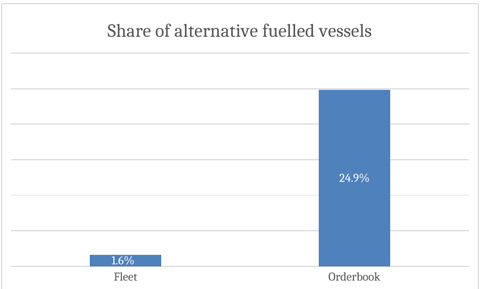
Certainly, the share of alternative-fuelled vessels in the dry bulk fleet is growing, and their share in the orderbook is even higher.
We have also observed that more fuel-efficient vessels, including eco-vessels and younger ships, are increasingly being used for Europe-related voyages. The share of these vessels calling at European ports during 2025–2026 has increased compared to previous years, partly to reduce costs associated with the EU Emissions Trading System (EU ETS). Therefore, we are already seeing differences in vessel distribution according to fuel efficiency and regulatory costs.
Alternative-fuelled vessels: Vessels that use an alternative fuel to conventional marine fuel.
Orderbook: Vessels that shipping companies have ordered to be built and have not yet entered service.
Eco vessels: Vessels that are more fuel-efficient.
EU Emissions Trading System (EU ETS): A system that imposes a cost on emissions covered by European regulation.
Infographic 5: Share of alternative-fuelled vessels in the current fleet and in the new vessel orderbook.
Source: Drewry Maritime Research and Clarksons Research
The Simandou project in Guinea has the potential to reshape global iron ore trade, targeting annual exports of 120 million tonnes when it reaches full capacity. How could increased iron ore shipments from Guinea to China affect the demand for Capesize vessels, voyage distances, and the competitiveness of established suppliers? What indicators will signal that the project is beginning to have a structural impact on the dry bulk market?
A shift in iron ore trade flows from the Australia–China route to the Guinea–China route will increase the utilisation rate of Capesize vessels. When the Simandou project reaches its target of exporting 120 million tonnes per year, which is likely to happen by 2030, the Guinea–China trade will require approximately 180 Capesize vessels, compared to about 64 vessels for the same quantity from Australia, due to the significantly longer sailing distance from Guinea.
A round voyage between Guinea and China takes over 90 days, nearly three times the duration of an Australia–China voyage, which takes 30–35 days. As a result, each Capesize vessel operating on this route completes fewer voyages annually, increasing the demand for vessels to transport the same quantity of goods.
This shift could lead to a net demand for approximately 116 additional Capesize vessels, representing one of the largest projected expansions this decade in demand linked to cargo volume and transport distance in the dry bulk sector.
The number of Capesize vessel calls at iron ore ports in Guinea will be an important indicator to monitor. As this number begins to increase significantly, we should start to see its impact on vessel demand and potentially on charter rates. We are talking about the potential transport of 100–120 million tonnes of iron ore on the Guinea–China line, which will have a considerable impact on Capesize vessel demand and utilisation.
Simandou project: A project to develop iron ore resources and exports in Guinea.
Vessel utilisation: How busy and utilized a vessel is in transporting cargoes.
Round voyage: A voyage that includes going to a destination and returning.
Tonne-mile: A measure combining the quantity of cargo transported and the distance over which it is transported.
Given geopolitical tensions, fuel price volatility, shifts in raw material sourcing, technological advancements, and climate-related risks, what three factors do you expect to have the greatest impact on the dry bulk shipping market in the next three to five years? And what indicators should Arab steel companies monitor to make better purchasing, inventory management, and chartering decisions?
Answer: I place geopolitical risks among the most prominent direct threats. By their nature, geopolitical disruptions are unpredictable, and any future event may or may not have a significant impact on the dry bulk shipping market. However, geopolitical factors will remain an important source of risk threatening trade flows, vessel distribution, and shipping rates.
Second, I will closely monitor regulatory pressures, whether from the International Maritime Organization (IMO) or at the regional level. Regulations can affect the dry bulk shipping market by reducing sailing speeds, increasing vessel lay-ups and demolitions, limiting new building orders, raising compliance costs, and extending the timelines for vessel upgrades and maintenance.
Finally, steel companies should follow regional measures such as the Carbon Border Adjustment Mechanism (CBAM), the EU Emissions Trading System (EU ETS), and FuelEU Maritime. These are key areas that require closer monitoring and planning due to their potential impact on trade flows, vessel selection, and shipping costs.
International Maritime Organization (IMO): The UN agency concerned with shipping safety and the prevention of pollution from ships
Carbon Border Adjustment Mechanism (CBAM): A European mechanism related to the carbon content of certain imports
EU Emissions Trading System (EU ETS): A system for pricing emissions covered by it
FuelEU Maritime rules (FuelEU Maritime): European rules aimed at gradually reducing the carbon intensity of energy used in maritime transport.