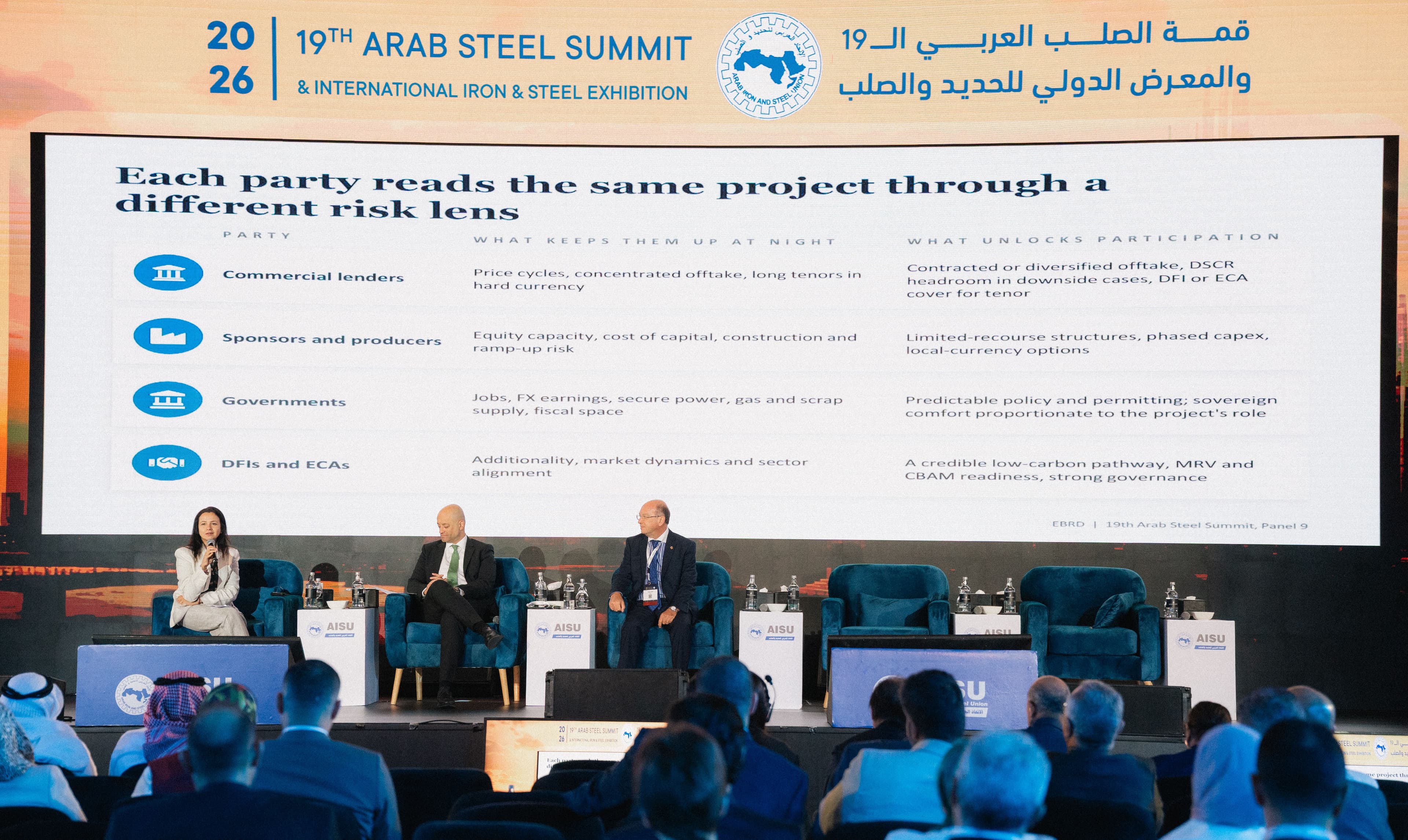
The ninth session of the 19th Arab Iron and Steel Summit, held in Cairo on November 3 and 4, discussed financing models for iron and steel projects, and mechanisms for combining governmental, institutional, and banking finance within an integrated financing package, in light of the significant increase in project costs and the magnitude of the required investments, in addition to the financing requirements for the transition towards low-carbon production and readiness for regulatory changes in global markets.
The session was titled 'Financing Models for Iron and Steel Projects: An Integrated Approach to Attract Governmental, Institutional, and Banking Finance within an Effective Financing Package', and was moderated by Ahmed Nabil, Board Member of Ezz Steel, with participation from Menna Zekrallah, Vice President, Corporate Banking, Egypt at the European Bank for Reconstruction and Development, and Hatem El-Demerdash, Head of Global Advisory and Capital Markets at the African Export-Import Bank (Afreximbank).
Ahmed Nabil: The High Cost of Iron and Steel Projects Necessitates External Financing
Ahmed Nabil, Board Member of Ezz Steel, affirmed that the significant increase in the costs of establishing iron and steel projects, along with the magnitude of the required investments, makes external financing a necessity for implementing new projects and industrial expansions, given the inability of investors or shareholders to necessarily provide the full financing themselves.
Nabil explained, during the session's opening, that the discussions at the summit addressed opportunities for adding new production capacities, alongside vertical integration projects in upstream and downstream production stages, and the completion of existing projects, noting that producers and suppliers participating in the summit have plans for major projects that require substantial financing.
He indicated that the cost of iron and steel projects, whether standalone or integrated, has doubled or tripled over the past five to ten years, due to a combination of factors, including the trend of a large number of suppliers towards the direct reduced iron (DRI) and electric arc furnace (EAF) production route, and the associated pressures on equipment suppliers, in addition to the rise in prices of basic materials, such as iron, aluminum, and copper, as well as increased costs for equipment, automation, and shipping.
He added that assembling the required financing in stages and from scattered sources can take a long time, and investors or shareholders may not have the capacity to provide the full investments needed for the project, which enhances the importance of utilizing external financing sources.
He explained that these sources include commercial and Islamic banks, multilateral financial institutions, and export credit agencies, noting that Project Finance represents a suitable framework for gathering these financing sources within a single structure.
He pointed out that the discussion during the session aims to clarify how this financing framework is applied, the risks that financing entities consider, and the mechanisms for distributing them among the participating parties, before the speakers present their views on the role of financial institutions in supporting steel projects, with a focus on green finance.
Menna Zekrallah: Alignment of Producers, Banks, and Governments is a Prerequisite for Financing Low-Carbon Steel Projects
Menna Zekrallah, Vice President, Corporate Banking, Egypt at the European Bank for Reconstruction and Development, stated that the successful financing of major steel projects requires the preparation of financing packages capable of withstanding market cycles, and achieving alignment between the interests of producers, lenders, governments, and development finance institutions, while considering the decarbonization pathway and readiness to implement the European Carbon Border Adjustment Mechanism (CBAM).
She explained that the concerned parties view projects from different perspectives; commercial banks focus on price cycles, off-take agreements, and risk diversification or concentration, while producers and project owners are concerned with the cost of capital, diversifying the lender base, and the possibility of obtaining limited recourse financing, whereas governments focus on job opportunities and foreign exchange provision.
She added that development finance institutions and export credit agencies play a role in aligning the interests of these parties, which helps in building a viable financing structure, noting that the success of projects requires appropriate market dynamics and agreement among parties on a common goal.
Regarding steel market developments, Zikr Allah pointed out that the market is undergoing a phase of re-stabilization, with OECD forecasts expecting global market growth of about 1% annually, in light of the continued excess production capacity, the start of the European Carbon Border Adjustment Mechanism payments early next year, and differing price trends across geographical regions.
She noted that emission reduction technologies are still in the experimental stages and need to prove their feasibility on a larger scale, warning against linking technology selection decisions to market conditions or prices that have not proven sustainable. In this context, she pointed to the delay of some hydrogen injection projects due to their reliance on market conditions that were not ready.
She affirmed that carbon reduction projects can rely on increased scrap utilization or furnace conversion, noting that the Arab region has a good baseline in terms of emissions per ton of steel produced, and that what is required is a gradual and clear path for emission reduction, based on solutions that have proven financially viable, without relying on future price premiums for green steel.
She revealed that the European Bank for Reconstruction and Development's portfolio in the steel sector is close to 220 million euros, and that the bank is working this year to finance 9 projects in various countries, four of which have been signed, including projects in Uzbekistan, Albania, and Romania.
She explained that the success of these projects is linked to the cooperation of producers, banks, international finance institutions, and governments, and the provision of an appropriate policy mix, emphasizing the importance of discussing the financing structure at an early stage to enhance financing success opportunities. She added that carbon reduction and financing green projects for the steel industry in Egypt are priorities for the bank, given the sector's importance to the European Carbon Border Adjustment Mechanism.
Hatem El-Demerdash: Feasibility studies, risk distribution, and contractual guarantees are key to financing iron and steel projects.
Hatem El-Demerdash, Head of Global Advisory and Capital Markets at the African Export-Import Bank (Afreximbank), affirmed that qualifying iron and steel projects for financing requires preparing updated and bankable feasibility studies, along with providing the necessary infrastructure, including contingency reserves, and securing long-term raw material supply and sales agreements.
He explained that project owners and industry experts possess extensive knowledge of the sector, supply and demand trends, and competition, but this knowledge does not necessarily mean that the requirements for preparing a bankable feasibility study are complete. This necessitates updating studies for new projects and existing expansions, verifying the assumptions used, and considering market developments.
He pointed to the importance of government support and the provision of supporting infrastructure for projects, explaining that linking an iron ore mine to a factory is an example of this. If this infrastructure is not ready, its cost must be included in the total investments required for the project's development.
He added that financial models and financing structures, which combine equity and debt, should include provisions for contingencies to address unexpected costs, without a fixed percentage applicable to all projects.
He stressed the necessity of concluding long-term agreements for the supply of scrap, raw materials, gas, and energy, with clear formulas and equations for price determination instead of relying on fixed prices, in addition to ensuring long-term sales agreements to secure the disposal of production.
He pointed to the importance of addressing the mismatch between the currency of financing and the currency of revenue, especially when a project obtains financing in foreign currency to cover Engineering, Procurement, and Construction (EPC) contracts, while its revenues are generated in local currency. He indicated that these risks can be managed through hedging, exports, or other suitable solutions.
He explained that the financing structure can include multiple tiers, encompassing equity, mezzanine financing, and senior debt, alongside development finance institutions and export credit agencies, emphasizing the importance of engaging consultants with expertise in aligning risks with the requirements of various financing institutions.
He presented the example of Tosyali Algeria, which raised approximately 15 billion dinars through the local stock exchange, noting that local capital markets can serve as a supplementary source of local currency financing.
He also referred to the rehabilitation project of the railway line connected to the mine and port of the National Industrial and Mining Company (SNIM) in Mauritania, which secured financing worth $150 million, clarifying the importance of including the infrastructure costs associated with the project within the necessary investments for its implementation.