Mona El-Garf: Global Surplus and Protectionist Measures are Challenges Pressuring the Steel Industry
745 Million Tons of Surplus Expected in 2028, and Arab Coordination to Protect Regional Markets is No Longer a Luxury
18.2 Million Tons of Arab Capacity Surplus and Market Challenges Exceed Production
From Cairo.. A Call for Coordinated Arab Action in the Face of Steel Surplus and Trade Restrictions
The Arab Steel Summit will be held in Cairo on November 3 and 4, 2026, at a crucial time, as the challenges facing the steel industry go beyond the usual recession, and competition intensifies between surplus production and slowing demand on one hand, and trade and environmental restrictions on the other. The summit comes at a time when global production capacity surplus is heading towards record levels, and major economies are prioritizing supply security and protecting their industries, posing a challenge for Arab producers to protect their markets and exports and prepare for the green transition.
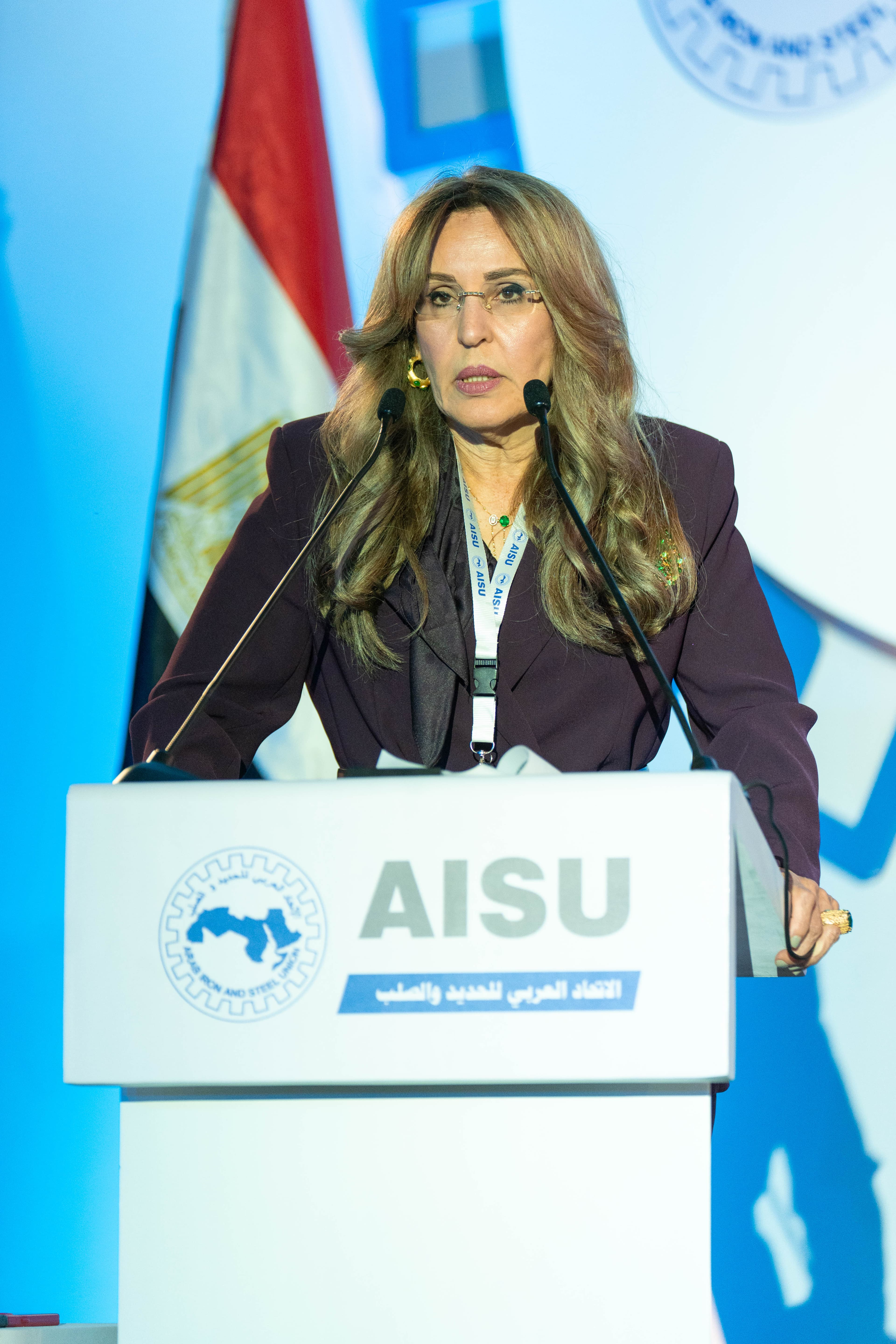
On these axes, "Arab Steel Bulletin" interviews Dr. Mona El-Garf, Professor of International Economics at Cairo University and former head of the Egyptian Competition Protection and Anti-Monopoly Practices Authority, to understand the transformations in the global market and their repercussions on the Arab industry and the priorities for action. This interview took place on the sidelines of the training course organized by the Arab Iron and Steel Union in cooperation with Ezz Steel Group in mid-October, titled "Legal Frameworks for Trade Remedies."
El-Garf says that the summit gains special importance at this time as an opportunity to transform common challenges into a practical Arab agenda, including unifying positions, improving data exchange, stimulating demand, and linking industry protection with its reform and efficiency improvement. Arab countries are not the source of the global crisis, but they face its effects with varying capabilities in production, consumption, and trade defense. And here is the text of the interview:
What does the current state of the global steel industry and trade look like?
The steel industry is a pillar of the real economy and an important element of economic security, as it provides essential inputs to many sectors. Developed economies account for about 91% of global crude steel production. However, the industry faces a slowdown in trade growth, supply chain disruptions, geopolitical tensions, and a shift in the priorities of major countries from efficiency alone to supply security and the protection of domestic industries.
This coincides with the rise of industrial policies, government support, and increasing protectionist measures, while the Appellate Body of the World Trade Organization has remained paralyzed since 2019. In general, the risks of the disintegration of the global trading system could reduce the exports of developing countries by about a third by 2030, and by about 43% for low-income countries, and reduce the GDP of developing countries by about 5.1% according to various estimates.
What are the most prominent imbalances in the global steel market?
Six challenges are intertwined. The first is the widening gap between production capacity and demand: global capacity increased from 2.413 billion tons in 2019 to 2.445 billion tons in 2025, while demand decreased from 1.891 billion tons to 1.805 billion tons. The second is the accumulation of surplus; it reached about 640 million tons in 2025 and is expected to reach 745 million tons by 2028. This means that the available capacity exceeds what demand can absorb by this amount, and the gap is likely to widen.
The third is unequal government support. According to an analysis by the Organization for Economic Co-operation and Development (OECD), the support received by Chinese steel companies is about 15 times that of their counterparts in other economies when measured as a percentage of assets. Estimates of support per ton exported in 2024 also reveal: $270 in China, compared to $55 in the European Union, $40 in Japan, $35 in South Korea, and $25 in the United States. Added to this is China's influence through capacity, exports, and foreign investment, the rise of unfair trade practices, and the expansion of protectionist tools and non-tariff barriers.
And how does the surplus affect the profitability of companies and expansion investments?
Surplus puts pressure on prices and profit margins, increasing the risk of investing in capacity not matched by sufficient demand. It may also distort competition, displace less efficient plants, and limit companies' spending on quality, development, and environmental compliance. Weak profitability may slow investment in emission reduction technologies and the green transition, despite their growing importance for competitiveness and market access. The organization expects average annual growth in global demand of about 0.9% until 2030, making expansion unrelated to market needs a factor in exacerbating the imbalance.
What are the aspects of Chinese influence in the steel market?
It is based on three paths: expanding domestic capacity beyond demand growth, increasing exports, and then expanding investments abroad. Chinese production capacity reached 1.136 billion tons in 2025, accounting for 46.4% of global capacity, and China represented about 54% of the global capacity-demand gap in the third quarter of that year. Its exports also exceeded 131 million tons in 2025, an increase of 153% compared to 2020.
Does investment-driven dumping pose an additional challenge to the global steel industry?
Investment-driven dumping is the transfer of part of production to plants and investments outside the exporting country to dispose of surplus and access new markets. The presentation refers to Chinese projects in Asia and moves towards Africa and the Arab region. The challenge is to distinguish between genuine industrial investment that adds local value and any arrangements that may be used to change origin or circumvent restrictions, as suspicions can subject the host country's exports to trade investigations.
Will protectionism succeed in solving the overproduction surplus crisis?
The share of steel in applied trade remedy measures increased from 33.4% until 2014 to 43.4% in 2025. Tools such as anti-dumping, countervailing duties, and safeguard measures may be legitimate when harmful practices are proven, but they alone do not address excess capacity. Restrictions may divert trade to other markets, leading to a new wave of restrictions.
The biggest problem with protectionist measures is that they go beyond traditional tariffs. The United States imposed a 50% tariff on steel imports under Section 232, and the European Union began implementing measures in July 2026 that include reducing quotas by an average of 60% and raising tariffs to 50% on imports exceeding quotas. Sustainability requirements and verification of production activity and investment are also expanding.
What is the reality of the Arab industry in terms of production and global surplus?
The figures confirm that Arab countries are not the source of the crisis. In 2024, Arab liquid steel production capacity reached 60.17 million tons, or 2.4% of global capacity, and actual production reached 41.96 million tons, or 2.2% of global production. Excess capacity was estimated at about 18.2 million tons, or nearly 3% of the global surplus. Saudi Arabia, Egypt, Algeria, and the UAE led Arab producers in 2025 data, with production reaching 10.8, 10.6, 5.3, and 3.8 million tons, respectively.
However, the region's limited contribution to the surplus does not mean it is immune to its effects; steel is being redirected to less protected markets, while Arab exports face trade investigations and increasing environmental requirements.
Does Arab steel consumption reveal opportunities for growth?
There is a wide disparity between countries. Average apparent per capita consumption in the Arab region was 116.3 kg in 2024, compared to 215 kg globally. The UAE recorded 777 kg, Kuwait 368 kg, and Saudi Arabia 362 kg; while consumption was 85.7 kg in Egypt, 77.8 kg in Tunisia, and 5.2 kg in Sudan. This gap highlights an area for stimulating demand and developing infrastructure and manufacturing industries, while linking production expansion to actual market needs.
Do Arab countries possess sufficient trade defense tools?
Supply data indicates that Egypt, Morocco, and Saudi Arabia used anti-dumping investigations against steel imports during the period in question. In contrast, exports from six Arab countries faced 31 international investigations between 2014 and 2025: 27 for anti-dumping and four for subsidies. Egypt and the UAE led the number of investigations, with about two-thirds originating from the United States and Canada. The years 2024 and 2025 saw the launch of 13 new investigations, including those concerning Egyptian and Algerian rebar in the United States, and Egyptian hot-rolled steel in the European Union.
Dealing with this requires accurate data on prices, costs, inputs, and supply chains, as well as technical and legal expertise, and Arab cooperation instead of individual responses.
How do environmental and digital requirements and scrap restrictions affect the Arab steel industry?
Three challenges emerge. First, the European Carbon Border Adjustment Mechanism (CBAM), which links cost to the carbon emissions embedded in imports; this increases the importance of reducing, measuring, and disclosing emissions, especially with the potential use of high default values in the absence of reliable data.
Second, the digital product passport, which requires transparent data on the environmental footprint, material origin, and recyclability. The absence of digital infrastructure may complicate compliance proof and expose exports to risks of delayed access or rejection. Third, restrictions on exporting scrap and solid waste to countries outside the OECD, which may pressure Arab factories reliant on imported scrap, particularly electric arc furnaces. The presentation indicates that Turkey enjoys greater flexibility in securing scrap, which may give it a cost advantage.
Third: Recommendations and Arab Action Priorities
What reforms are needed?
A coordinated Arab response is required, combining the defense of commercial interests with industrial reform and demand stimulation, through four pathways:
1. Arab Alliance and Data Platform: Establish a steel alliance similar to the Global Forum on Excess Production Capacity (GFSEC), led by the Arab Iron and Steel Union, with an updated platform for production capacities, demand, and an early warning mechanism to monitor surplus, investigations, and trade shifts, and periodic meetings between governments and industry.
2. Coordination of Trade Defense and Investment Governance: Exchange expertise in anti-dumping, subsidies, and safeguard measures, and unify the Arab position in the World Trade Organization. Establish clear frameworks for examining foreign investments, welcoming genuine investment and limiting risks of circumventing rules of origin. This is paralleled by coordinating subsidy policies to avoid unmanaged Arab competition and entrench competitive neutrality.
3. Collective Negotiation for Green Transition: Coordinate dialogue with the European Union regarding CBAM and the recognition of carbon certificates and data, and seek partnerships for technology transfer and concessional climate finance. This includes developing green steel, using renewable energy and hydrogen where feasible, improving energy efficiency, and reducing emissions.
4. Industrial Integration and Demand Stimulation: Link raw material producers, such as iron ore and gas, with countries having manufacturing capabilities, and unify quality specifications to facilitate intra-Arab trade. An Arab fund could be studied for modernizing factories and improving their environmental performance and energy efficiency. Demand should also be stimulated, and mergers and acquisitions studied when enhancing efficiency, voluntary production reduction when necessary, and expansion into specialized high-value products.
What is the most important message for the Cairo Summit?
Arab countries are not the source of global surplus, but they are among its victims. Individual protectionism is insufficient; a coordinated Arab move is needed, based on reliable data, combining trade defense with demand stimulation, factory modernization, value chain development, and green transition. The Cairo Summit is an opportunity to agree on common priorities and follow-up mechanisms that safeguard the industry's competitiveness and international interests.