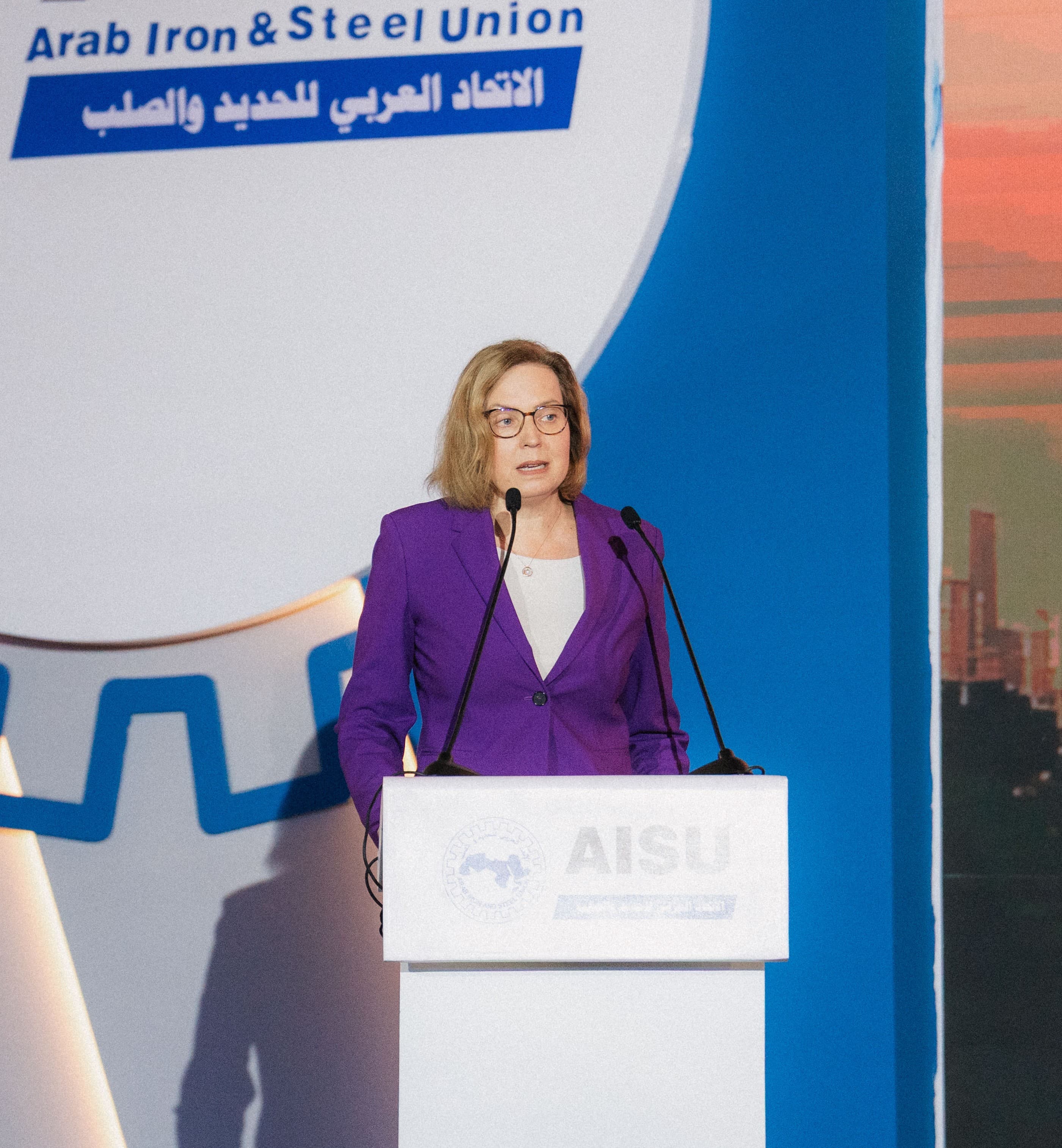
Nicole Voigt, Managing Director at Boston Consulting Group (BCG), stated that the EU's new steel trade quota system does not support green steel imports, as it relies on historical import data to determine country-specific quotas without considering the carbon emission intensity of products. This poses challenges for new low-carbon steel production projects seeking market access in Europe.
She added that the shifts in European trade rules, along with the developments of the Carbon Border Adjustment Mechanism (CBAM) and the trends aimed at stimulating domestic demand for low-carbon steel, represent three key pillars reshaping steel trade and competitive opportunities in the European market.
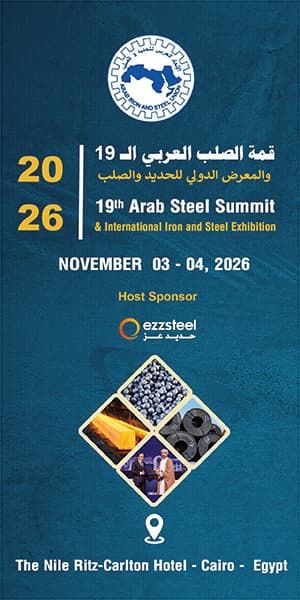
This came during her participation in a specialized session on the Carbon Border Adjustment Mechanism (CBAM), as part of the 19th Arab Steel Summit, held in Cairo on November 3rd and 4th.
Voigt explained that approximately 25% of finished steel products enter international trade, while the remaining portion is consumed domestically. She noted that her presentation covered the developments of the new trade defense system in Europe, the CBAM, and the measures taken by the United States to support domestic demand.
She pointed out that the most significant changes in the new European trade system include a 46% reduction in steel import quotas and raising customs duties on imports exceeding the allocated quotas to 50%.
She explained that the decline in domestic steel demand in Europe, while imports remained at their absolute levels, led to an increase in their market share. This prompted local producers to demand protectionist measures, given the pressure on their profit margins due to increased competition from imports.
She added that the new system reduced total quotas to 18.3 million tons, indicating that projections suggest a decrease in the import share of the European market to about 13%, which the European industry had been aiming to achieve.
Voigt emphasized that the change in the trade defense system is not limited to reducing quota volumes but also includes a fundamental shift in their allocation mechanism, which now depends on a country's status regarding free trade agreements with the EU, in addition to its historical import volumes.
She explained that countries with free trade agreements are subject to a system combining free trade quotas and Most Favored Nation (MFN) quotas, while countries without such agreements are subject to MFN quotas.
She also noted that countries whose historical imports exceed 5% receive independent country-specific quotas, whereas countries with historical imports below this threshold do not receive independent quotas but compete for the remaining quotas.
She added that the system includes quotas allocated to free trade agreement countries and other remaining quotas for countries subject to the MFN system, with some quotas available on a first-come, first-served basis. She clarified that independent country-specific quotas do not allow for the carry-over of unused quantities or their transfer to subsequent periods.
She pointed out that countries with free trade agreements with the EU retained between 50% and 65% of their previous quota volumes, while countries without this status retained only about 30% of their previous quotas, reflecting a difference in the new system's impact on exporting countries.
Regarding the new system's impact on green steel trade, Voigt stated that the allocated quotas do not necessarily support low-carbon steel imports because they are based on historical import patterns, not on the carbon emission levels of the products.
She explained that countries like India, Turkey, South Korea, and Ukraine, whose production relies on traditional blast furnaces, received quotas under the new system, while some countries developing green steel production projects do not have similar quotas.
She added that this makes the new trade system, in her description, carbon-blind, as it does not favor low-emission imports nor does it consider new projects aimed at producing green steel.
She pointed out that countries without quotas will be forced to export their products to Europe outside the quotas, bearing customs duties of 50%, which could make these exports economically unfeasible.
In this context, she explained that Hot Briquetted Iron (HBI) is not subject to the same restrictions imposed on products covered by the quota system, allowing its continued export to Europe. She also indicated the possibility of exporting semi-finished products, while anticipating that they may be subject to restrictions in the future.
Foit reviewed the initial data for the implementation of the new trade system, which came into effect on July 1st, explaining that steel imports during the third quarter amounted to approximately 4.6 million tons, with 83% of the available quotas used.
She indicated that the non-utilization of full quotas may be due to the impact of inventory, as importers were not fully aware of the implications of the new system, prompting some to build up stocks. Additionally, some quotas were not utilized due to anti-dumping duties on the products.
She cited the example of Egypt's quota for hot-rolled steel coils (HRC), noting that the existence of anti-dumping duties affects the ability to utilize the allocated quota.
She also suggested that the complexities of the new system and the small size of some quotas allocated to several countries would make them difficult to use, emphasizing that assessing the system's impact requires monitoring data over the coming quarters, as the available data still pertains to the first quarter of its implementation.
Foit then moved on to discuss developments related to the Carbon Border Adjustment Mechanism (CBAM), noting that one of the currently discussed files concerns expanding the scope of products covered by the mechanism to include later stages of the steel production chain.
She explained that domestic producers in Europe are calling for the expansion of the application to include finished products, similar to the approach adopted by the United States under Section 232, in order to avoid circumvention of measures by importing manufactured products at later stages.
She added that there are ongoing discussions regarding the products that will be subject to the mechanism, as well as the issue of relying on verified emissions or default values, noting that proposals to expand the scope of products are still under discussion.
She pointed out that the discussions have seen an increase in the number of products proposed for inclusion within the scope of the mechanism compared to the European Commission's initial proposals, with expectations of further details emerging regarding the final direction of these adjustments.
Foit stressed the importance of relying on verified emissions rather than default values when calculating obligations related to the Carbon Border Adjustment Mechanism, explaining that default values are significantly higher than actual verifiable emission levels.
She presented an example for Turkey, illustrating that relying on verified emissions leads to lower additional costs compared to relying on default values, which could triple the cost in the case of hot-rolled steel coils.
She also addressed the case of Egypt, noting that producers relying on the Electric Arc Furnace (EAF) production route, with verified actual emissions, can achieve an advantage compared to European producers relying on traditional smelting furnaces.
She added that the failure to provide documented emission data leads to the application of default values, which do not include an independent value for Egypt in the example she presented, but rather rely on default values applied to other countries. This could significantly increase the compliance cost beyond that borne by the local European producer.
She affirmed that emission verification represents an economic advantage for exporters, and its impact is not limited to hot-rolled steel products but extends to other products, including cold-rolled steel coils. She noted that emission verification processes are still limited according to Boston Consulting Group's estimates.
Foit also touched upon European trends aimed at supporting domestic demand for low-carbon steel, noting that two legislative proposals are under discussion. The first is the Industrial Accelerator Act.
She explained that the act includes requirements for the use of low-carbon steel in public procurement, as well as in projects eligible for support programs in the private sector, stipulating that low-carbon steel must represent 25% of the product to be eligible for these programs.
She added that the definition of low-carbon steel has not been definitively determined yet, and the related guidelines are still under discussion.
She pointed out that the initial proposals did not include requirements related to local origin, before the European Parliament proposed a measure combining low carbon and local origin, including establishing a local definition for imported hot-briquetted iron.
She expressed her belief that the implementation of this trend may face difficulties, given the insufficient availability of hot-briquetted iron within Europe, clarifying that the proposal includes needs for flat and long steel, in addition to hot-briquetted iron.
The second proposal relates to the regulation of vehicle fleet emissions, which aims to address the challenges faced by automotive manufacturers in achieving emission reduction targets at the required speed.
Foit explained that the proposal allows car manufacturers to offset penalties related to vehicle exhaust emissions through savings generated from using green steel instead of traditional steel.
She added that this trend could create additional demand for low-carbon steel, noting that hot-briquetted iron can be included among the materials used to achieve these goals, whether produced using green or traditional pathways, according to the proposal she presented.
She pointed out that the date for the regulation to enter into force has not been definitively set, as the official date indicates 2035, while there are efforts to push for bringing the application date forward to 2030.
In conclusion to her presentation, Foit identified three main areas that steel producers and exporters must address to keep pace with the transformations in the European market.
She explained that the first area concerns the new trade system, urging exporters to act quickly to assess their available quotas and identify areas where they can compete, given the decline in quotas and changes in their distribution mechanisms.
The second area relates to the Carbon Border Adjustment Mechanism (CBAM), emphasizing the importance of investing in the verification of actual emissions to avoid additional burdens resulting from reliance on default values.
The third area involves monitoring European requirements related to the demand for green steel and local origin, and studying opportunities for exporting hot-briquetted iron to Europe.
Foit concluded her presentation by emphasizing the importance of monitoring changes in European trade rules, preparing for emission verification requirements, and evaluating the opportunities that new legislation may offer to steel exporters.