"Steel Wars".. Arab Steel Summit Discusses Plan to Confront Protectionism and Utilize Unused Capacity
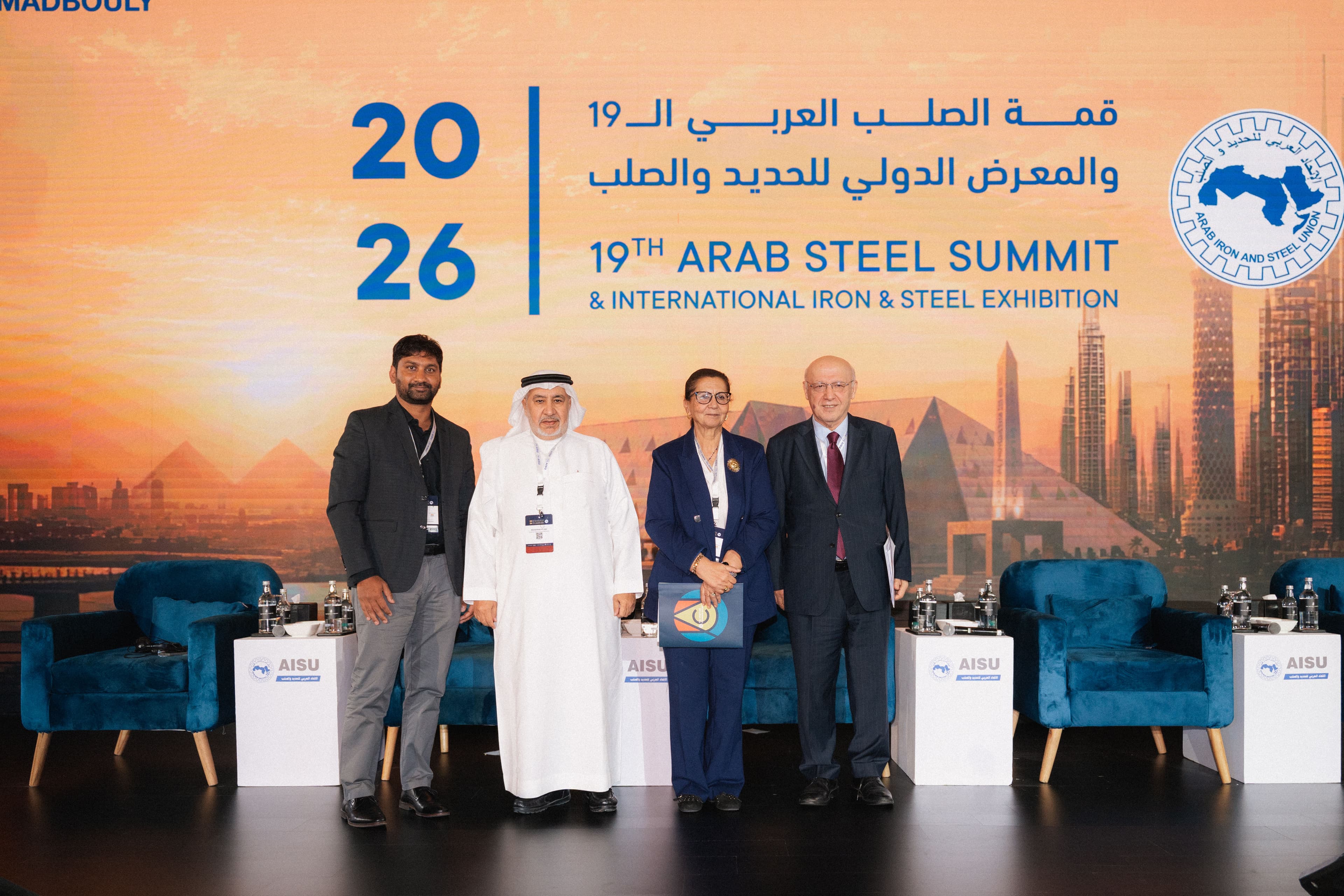
The sixth session of the second day of the 19th Arab Steel Summit, held on the second day of the Arab Steel Summit's proceedings in Cairo from November 3rd to 4th, 2026, discussed the prospects of the global steel industry in light of escalating trade protectionism, the widening gap between production capacity and demand, and the changing map of production and consumption, in addition to the impact of energy costs and carbon emissions on producers' competitiveness and market access opportunities.
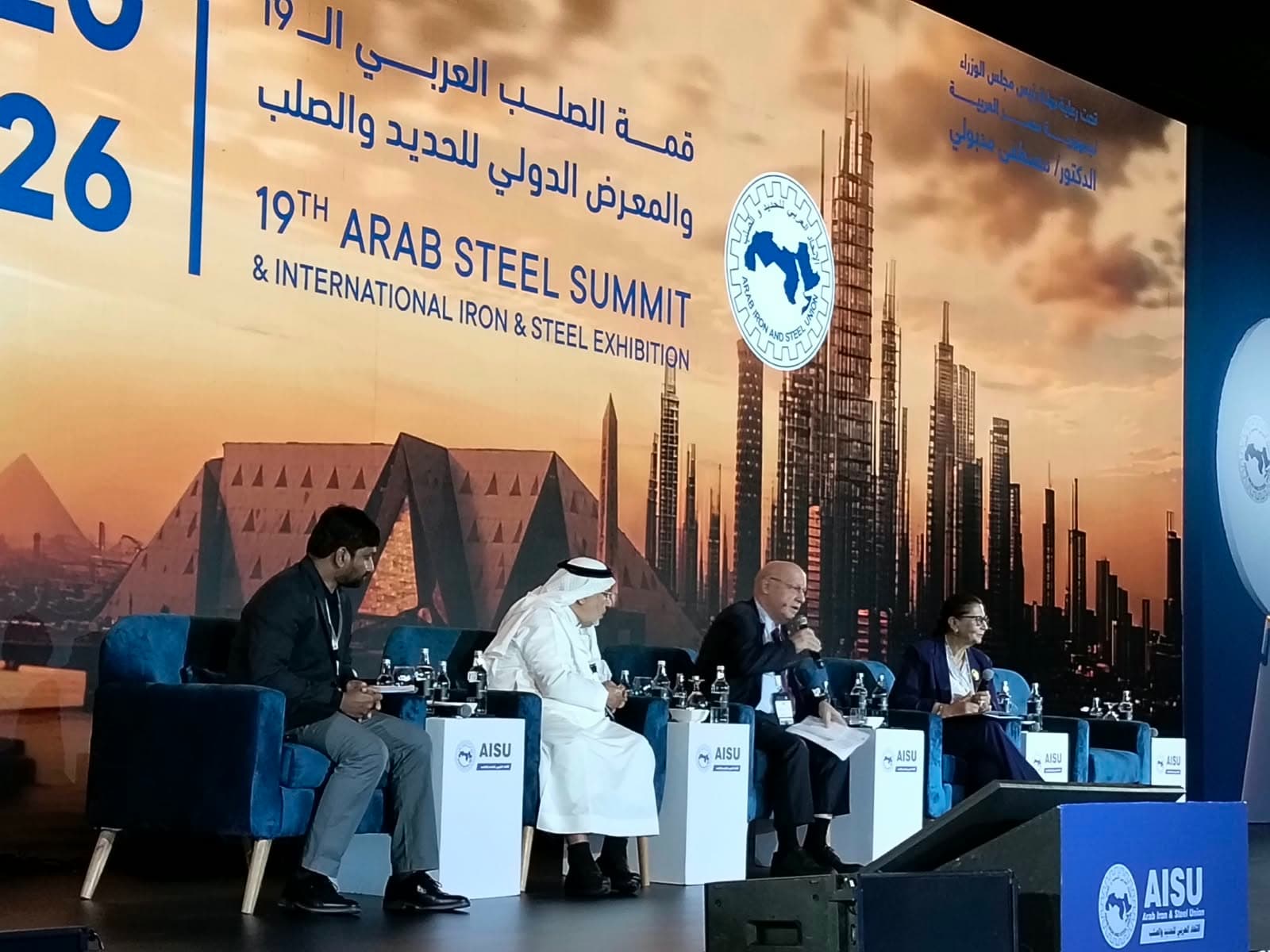
The session was held under the title "Prospects of the Global Steel Industry: Risks, Opportunities, and Strategic Priorities," with the participation of Dr. Alia El-Mahdy, former Dean of the Faculty of Economics and Political Science at Cairo University, Dr. Veysel Yayan, Secretary-General of the Turkish Steel Producers Association, Mohamed El-Gabr, Consultant and Expert in the Iron and Steel Sector, and Sunil Seebana, Senior Steel Sector Analyst at CRU. El-Mahdy moderated the session, beginning with a question to Yayan about the comparison between the rise in global production capacity and weak demand, and its impact on the stability of international prices.
The speeches addressed the impact of new trade policies on global steel movement, the repercussions of excess production capacity on prices and investments, the regions projected to lead demand growth in the coming years, as well as the challenges posed by production costs and the transition to low-emission technologies for producers, especially in the Middle East and North Africa region.
Alia El-Mahdy: The steel industry has entered the era of "Steel Wars" and needs an Arab plan to confront protectionism and utilize unused capacity
Dr. Alia El-Mahdy reviewed the transformations in global trade and the iron and steel industry since 2018, pointing out that the world has gradually moved away from the principles of free trade, with developed economies increasingly protecting their domestic industries, while developing countries strive for industrial expansion, product quality improvement, cost reduction, and export growth.
She explained that this shift has led to an escalation of trade restrictions and protectionist measures, which are no longer limited to customs duties but have extended to safeguard duties, anti-dumping duties, and countervailing duties, as well as restrictions on production inputs, such as scrap iron, chromium, and nickel, environmental requirements, and forms of government support for domestic industries.
She stated that the closure of major markets to steel surpluses leads to the transfer of these quantities to other markets, triggering a chain reaction of trade wars, as countries affected by import surges resort to similar measures to protect their industries, which increases the difficulty of international trade and affects producers' market access opportunities.
She cited statements by Ursula von der Leyen, President of the European Commission, who considered that global steel overcapacity harms the industry and called for swift action and cooperation with member states, partners, and the World Trade Organization to address this problem.
She also reviewed the measures announced by European Commission Executive Vice-President Stéphane Séjourné and Trade Commissioner Maroš Šefčovič, on October 7, 2025, which included reducing duty-free steel import quotas to 18.3 million tons annually, a 47% decrease compared to 2024 quotas, and increasing duties on imports exceeding quotas to 50% instead of 25%, in addition to implementing the "Melt and Pour" country of origin requirement to trace product sources.
She noted the call by Axel Eggert, President of the European Steel Association (EUROFER), for the implementation of the new measures by July 1, 2026, to protect European industry, and also discussed the position of Kevin Dempsey, President of the American Iron and Steel Institute (AISI), who supported the measures taken by the administration of U.S. President Donald Trump and the increase in steel import tariffs to 50%.
Regarding raw material restrictions, Al-Mahdi explained that 48 countries and economies imposed restrictions on iron scrap exports during 2025, and that these restrictions cover only about 15.2% of global scrap trade. This coincides with the European Union's move to review its list of countries allowed to import scrap from it, which could increase restrictions on the availability of this raw material.
She also addressed the concentration of nickel production in Indonesia, pointing out that the presented data included the country's share of 61% of global refined nickel production in 2024, with its share expected to rise to 74% by 2028. She noted that restrictions on nickel ore exports pose a threat to the stainless steel industry's supply.
On the environmental requirements aspect, she indicated that the European Carbon Border Adjustment Mechanism (CBAM) will enter its final phase in January 2026, imposing requirements on iron and steel products. She cited estimates from the International Energy Agency (IEA) suggesting that the cost of producing low-emission steel could increase by 10% to 75% compared to traditional production, depending on the technology and region, with an average increase estimated at around $225 per ton by 2030.
Al-Mahdi then moved on to the issue of excess production capacity, explaining that the global capacity utilization rate reached about 76% in 2025, with the gap between production capacity and demand reaching about 640 million tons, and this is expected to rise to 745 million tons by 2028, according to data from the Organisation for Economic Co-operation and Development (OECD).
She added that global steel demand decreased by 2.6% in 2025, with limited growth of 0.4% expected in 2026. This exacerbates the pressures resulting from the continuous addition of new production capacities despite weak consumption growth.
She clarified that the average capacity utilization rate among the top 10 steel-producing countries was 70.7%, while it was about 70.1% in the six largest Arab steel-producing countries. This reflects the existence of underutilized capacities that can be leveraged instead of relying on increased imports.
She also pointed to the increase in coal prices by about 25% from January to October 2026, along with rising prices for scrap, oil, and gas, and an increase in shipping and transportation costs by about 30%, amidst geopolitical disruptions. This adds new burdens to production costs.
Despite these challenges, Al-Mahdi affirmed the existence of opportunities for the steel industry, especially in the field of low-emission production. She noted the increase in targeted production capacity for announced projects in this area from 105 million tons per year in 2020 to 142 million tons in 2026.
She stressed the importance of providing financing, tax incentives, government contracts, and procurement to support investments in low-emission steel, in addition to developing the necessary infrastructure for renewable energy and low-emission hydrogen.
She also highlighted opportunities for expansion in the production of specialized, high-value-added steel products used in the automotive, infrastructure, equipment, and renewable energy sectors, which helps producers diversify their products and not be limited to traditional grades.
She discussed the possibility of utilizing by-products from the steel industry and reusing them in other sectors, such as cement, roads, fertilizers, and power generation. She explained that Electric Arc Furnace (EAF) production generates about 200 kilograms of waste and by-products per ton of steel, compared to about 400 kilograms in blast furnaces.
She also emphasized the importance of digitalization, smart factories, and the use of artificial intelligence in improving operational efficiency, reducing waste, and conserving energy, which helps lower costs and increase productivity.
Regarding the Arab region, Al-Mahdi stressed the need to capitalize on underutilized production capacities, noting that Arab countries have about 30% of unutilized capacity, while the region imports about 18 million tons of steel annually. She considered this a contradiction that necessitates strengthening intra-Arab trade and directing production surpluses to neighboring markets.
It called for strengthening steel-related industries, foremost among them the construction, engineering, and white goods sectors, to contribute to increasing local demand and creating more stable markets for Arab producers.
Al-Mahdi concluded her speech by emphasizing that the steel industry has entered a phase she described as 'steel wars,' in light of escalating competition and trade restrictions, calling for a clear Arab plan to protect the industry and allow it to expand. This plan should include specific priorities and a timeline for implementation, while balancing supply and demand, reducing emissions, and expanding the use of clean energy.
Secretary-General of the Turkish Steel Producers Association, Veysel Yayan: Trade restrictions and government support disrupt the rules of competition and threaten the stability of the steel industry.
Dr. Veysel Yayan, Secretary-General of the Turkish Steel Producers Association, addressed the repercussions of global overcapacity on price stability and market access, emphasizing that the problem is not only related to increased production capacities but is exacerbated by non-market policies, government support, and trade restrictions that reshape the flow of exports and imports.
Yayan explained that the gap between production capacity and global demand is expected to widen in the coming years, pointing out that the data he presented, based on estimates from the OECD and the World Steel Association, showed an increase in the gap from approximately 591 million tons in 2024 to 640 million tons in 2025, with expectations of it rising to 707 million tons in 2026, 719 million tons in 2027, and then 745 million tons in 2028.
According to the presentation, global production capacity is projected to increase from approximately 2.443 billion tons in 2024 to 2.584 billion tons in 2028, while demand is expected to decrease from approximately 1.852 billion tons to 1.839 billion tons during the same period. He also noted that production capacities will increase by about 139 million tons during the presented period, compared to an increase in demand not exceeding 34 million tons.
He affirmed that the continued increase in supply amidst limited demand growth leads to reduced operating rates and pressure on prices and profit margins, which in turn affects companies' ability to invest, innovate, and improve resource and technology efficiency, in addition to its impact on jobs and supply chains.
Yayan linked some of the market imbalances to non-market policies, including grants, facilities, and credit provided under terms that do not reflect market prices, noting that these practices give some producers advantages not available to their competitors in other economies.
He discussed the growth of Chinese exports, explaining that China's steel exports reached a record level of 131 million tons in 2025, an increase of 153% compared to 2020, a volume that exceeds the total production of the European Union. He also pointed out that the level of support received by a typical Chinese steel company, when measured against assets, reaches about 15 times the support received by companies in other regions.
He added that Chinese companies have established production capacities outside China exceeding 70 million tons in Southeast Asia and Africa, noting the participation of at least one state-owned company in 70% of these cross-border investments.
He explained that weak domestic demand in some markets drives producers to export surpluses, increasing competition in open markets, especially as importing countries resort to tariffs, quotas, and safeguard measures that redirect trade flows from one market to another.
He indicated that imports entering markets at low prices put pressure on the margins of producers who rely on their domestic markets, citing the case of the Turkish industry, which has been affected by changes in US and European trade policies.
Yayan reviewed the development of US restrictions on steel imports, noting that the United States previously took measures under Section 201, then markets witnessed European moves at the beginning of the millennium, before protectionist measures were renewed in 2018 during the administration of US President Donald Trump.
He explained that the US measures in 2018 included Turkey, even though the stated justifications were linked to the trade deficit with China. He pointed out that tariffs on Turkish steel increased from 25% to 50%, and that the implementation of the measures faced objections related to investigation and inquiry rules. He also noted that US courts overturned the measure for a period before it was reinstated.
He said that Turkey's steel exports to the United States decreased from about 2.4 million tons to 150,000 tons after the imposition of tariffs, a level he described as negligible, reflecting the direct impact of the restrictions on trade flows.
He addressed the European measures, explaining that the European Union imposed quotas on steel imports due to concerns about trade diversion, and that these quotas decreased to about 38 million tons, before the Union moved to a new system that reduces them by 47%.
He indicated that Turkey's quota under the new system amounts to about 2.86 million tons, compared to exports of about 7 million tons in the previous year, meaning a loss of approximately 4 million tons of exports that are difficult to compensate for in other markets.
He added that Turkish producers tried to redirect their exports to Latin American markets and achieved increases in some countries. However, the total additional quantities they managed to export to these markets ranged between 300,000 and 350,000 tons, which does not compensate for the losses resulting from European restrictions.
Yayan affirmed that the continuation of these policies has led to a decline in confidence in the stability of the global trading system, noting that countries are now taking unilateral measures to protect their industries, without fixed rules that everyone adheres to. He warned that this trend could push other countries, including Arab nations, Turkey, and Russia, to adopt similar protectionist policies.
Yayan criticized the double standards in dealing with government subsidies, explaining that discussions in 2001 were moving towards eliminating state aid and modernizing the industry, and that limited aid to Turkish companies was then treated as a subsidy affecting competition. Meanwhile, European companies are currently receiving significant support under the guise of environmental protection and green transition.
He pointed out that European support for companies to help them transition to lower-emission production technologies, including electric arc furnaces, amounts to about $20 billion annually, considering that this raises questions about the consistency of standards applied by international institutions and major economies to producers in different regions.
He also criticized the way revenues from the European Carbon Border Adjustment Mechanism (CBAM) are handled, pointing to concerns that these revenues might be used or distributed in a way that grants European producers additional advantages, while exporters from outside the EU bear compliance costs and environmental requirements without receiving similar support.
He stressed that the differing rules for calculating emissions, their application methods, and carbon costs have become a factor affecting market access, and that European producers receive support for the green transition, while exporters face additional burdens related to energy costs and environmental compliance.
Yayan emphasized the necessity for competition to be based on transparent and predictable rules, and for carbon accounting to reflect actual production pathways and documented factory and emission data, not general assumptions. He warned that the continuation of protectionism and unequal support creates uncertainty for long-term investments, squeezes the margins of producers in developing countries, and limits their ability to invest.
He concluded by emphasizing that addressing trade distortions should not turn into restrictions that hinder legitimate competition, and that fair trade requires consistent application of rules to all producers, without double standards or discrimination between companies based on their geographical location.
Iron and Steel Sector Consultant and Expert Mohammed Al-Jabr: India and the GCC countries are the main drivers of steel industry growth in the coming years.
Mohammed Al-Jabr, a consultant and expert in the iron and steel sector, affirmed that India and the GCC countries represent the most promising regions for steel demand growth in the coming years, given the continued growth of the Indian economy and the expansion of urban and housing projects in the Gulf markets.
Al-Jabr explained that India recorded an economic growth rate of 8% during 2025 and is expected to maintain the same level during 2026, with hopes of it continuing at around 8% in 2027. He pointed out that its steel production reached approximately 150 million tons annually last year, while it aims to reach 160 million tons this year.
He added that the Indian market relies heavily on domestic demand linked to industrial and economic growth, which makes it one of the markets that continue to expand according to its internal needs, independent of concerns related to global oversupply.
Regarding the Middle East region, Al-Jabr indicated that the region recorded growth during 2025, despite the pressures on markets resulting from the repercussions of the war and destruction. He clarified that the figure he cited for current forecasts reached 13.9%, while the World Steel Association's Economic Committee expects growth ranging between 8% and 9% in 2027.
He highlighted the performance of the GCC countries, noting that the World Steel Association's Economic Committee report issued last October showed growth of about 17% during 2025.
He explained that housing projects in Saudi Arabia, the UAE, and a number of Gulf countries were among the most prominent drivers of steel demand in the region.
He added that forecasts for 2026 indicate growth of about 13% in GCC markets, with implementation affected by disruptions in supply chains, logistics operations, ports, and lockdowns.
Al-Jabr stressed that the expected decline in the growth rate does not reflect a decrease in steel demand, but rather is related to the postponement of the implementation of projects that have already been awarded and started, and for which the necessary funding has been secured. He pointed out that the delay in implementation is related to operational and logistical conditions, not to the cancellation of projects or a decline in the need for steel.
He predicted a return of demand growth rates in the GCC countries to their normal levels during 2027, ranging between 10% and 11%, noting that the World Steel Association's forecasts indicate global growth of about 1.7% in the same year.
Al-Jabr expressed his hope for an end to the war and a return to stability, which would allow the resumption of postponed projects and support the return of activity to regional markets in the coming period.
Sunil Sipani, Senior Steel Analyst at CRU: India and Southeast Asia lead global demand growth, and energy and carbon costs are reshaping producer competitiveness
Sunil Sipani, Senior Steel Analyst at CRU, reviewed the company's forecasts for the development of global demand, production, and trade during the period from 2026 to 2031, and the impact of these transformations on the MENA region. He indicated that the demand growth map is changing geographically, concurrently with changes in market access conditions and the increasing importance of energy and carbon emission costs in determining competitiveness.
He explained that the steel market has witnessed fluctuations during the year, resulting from varying demand levels, changes in trade policies, conflicts, rising energy prices, logistical disruptions, and supply concerns. He pointed to growth opportunities in some regions, while carbon-related policies create new challenges and opportunities for producers.
He indicated that the company's analysis focuses on three main axes: the regions that will lead demand growth and how production will respond to it, the changes in market access opportunities, and the impact of production costs and carbon emissions on company competitiveness.
Sebana confirmed that India and Southeast Asia will lead the growth in additional steel demand in the coming period. He explained that the presented figures do not represent regional growth rates, but rather each region's share of the net increase in global demand growth. The supply data showed that India and Southeast Asia account for about 71% of this increase in apparent demand for hot-rolled steel (HRC), followed by the Middle East and North Africa region with about 22%, then the rest of the world with about 20%, the Americas with about 16%, and Europe with about 13%.
In contrast, the data showed a decrease in China's share by about 42%, with a negative compound annual growth rate of 1.15%. Sebana stressed that this 42% decrease does not mean that Chinese demand will decrease by this percentage.
He explained that Chinese demand is expected to decline, according to the company's forecasts, from about 927 million tons in 2026 to about 875 million tons in 2031, at an annual decrease rate of approximately 1.2%.
He pointed out that demand growth varies by product type and region; in India and Southeast Asia, growth is distributed between flat and long products, while the Middle East and North Africa region records significantly higher growth in demand for flat products compared to long products, with long products continuing to maintain a large share of annual demand and achieving good growth.
As for China, demand for long products is expected to decline at a faster pace, due to its link to the real estate and construction sectors, and the absence of expectations for a real recovery in them, but rather a continued decline in the coming years.
Regarding production, he explained that China has been the primary driver of global steel production growth over the past 25 years, but forecasts for the period 2026-2031 indicate a decrease in Chinese production, whether for flat or long products, compared to production growth in other regions, which will compensate for this decline and lead to a net increase in global production.
Sebana addressed changes in international trade flows, explaining that China's steel exports to the Middle East declined during the year due to conflict and logistical disruptions, while its exports to other regions increased.
He added that the shortage of semi-finished steel supplies from the Gulf region led Chinese producers to change their export product mix to cover shortages in some markets, noting that this shift in export mix is a short-term phenomenon.
He predicted that China's exports will decline in the coming period, due to increased border protection and higher customs duties, in addition to increased production capacities within local markets, as well as the impact of carbon requirements on market access opportunities.
He affirmed that market access is no longer determined solely by demand levels, but is also linked to duties, quotas, trade restrictions, and the requirements of the European Carbon Border Adjustment Mechanism (CBAM), in addition to self-sufficiency levels and the availability of local supplies.
On the topic of production costs, Sebana presented CRU's analysis of the impact of rising energy prices on steel production costs during 2026, explaining that the analysis compares different production assets according to production routes and cost components, excluding the cost of reducing agents when measuring the impact of increased energy components.
The presented data showed that a 50% increase in the energy component leads to an increase in production cost at the 90th percentile of the cost curve by about $13 to $14 per ton, and that this increase is not uniform across all assets.
He explained that the impact of rising energy costs varies depending on the production technology, and that Electric Arc Furnace (EAF) assets are more exposed to rising energy costs compared to gas-based Direct Reduction assets, Blast Furnaces, and Basic Oxygen Furnaces (BF-BOF).
The presentation also included a comparison between oil and gas price scenarios and their impact on rebar production costs during 2026, covering the baseline scenario, a short escalation scenario during the fourth quarter of the year, and a deep escalation scenario, illustrating the sensitivity of production costs to geopolitical developments and energy prices.
Sebana then moved on to the relationship between production costs and carbon emissions, explaining that the CRU platform allows for the analysis of production costs and emission intensity at the industrial asset level, enabling a comparison of competitive advantages among producers in different regions.
The presentation reviewed a comparison of 2025 data between producers in the MENA region, China, and India, distinguishing between coastal and inland assets, and showing production volumes through the sizes of circles in the charts.
He indicated that MENA region assets are generally located at the lower end in terms of emission intensity, with variations in production costs among plants. This makes the assessment of competitive advantage linked to cost and emission levels, as well as the location of the production asset, simultaneously.
He explained that some Chinese export-oriented plants have low production costs and relatively low carbon emissions, and that as they continue to invest in clean technologies, they will compete for the same customers in a world where trade is linked to carbon costs.
He emphasized that this development requires producers in the MENA region to view competition from a broader perspective than just the availability of raw materials or low energy costs, as emission intensity and investments in clean technologies have become influential factors in export opportunities and customer retention.
Sebana concluded that global demand growth is shifting geographically, with its trends varying by product type, and that the opportunities for producers in the MENA region are linked to their ability to capitalize on the growth of regional markets, achieve a balance between cost and emissions, and deal with trade restrictions and market access requirements. He pointed out that demand growth alone does not guarantee the ability to enter these markets.
He stressed that any new additions to production capacities must consider geopolitical disruptions, energy risk exposure, trade restrictions, and most importantly, competitors' investments in cleaner technologies. He affirmed that the ability to compete in the coming years will be increasingly determined by production efficiency and environmental performance combined.