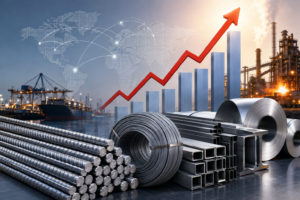




According to the latest report issued by the World Steel Association (worldsteel) on global steel demand for 2025 and 2026. Global steel demand in 2025 is projected to be flat compared to 2024, reaching about 1,750 million tonnes (Mt). A modest rebound of 1.3% is forecast for 2026, pushing global demand to 1,773 Mt.
Alfonso Hidalgo de Calcerrada, Chief Economist at the Spanish Steel Producers Association (UNESID) and Chair of the worldsteel Economics Committee, commented:
“Despite the significant escalation of the global trade war and ongoing uncertainties, we are cautiously optimistic that global steel demand will bottom out in 2025 and show moderate growth in 2026. This optimism is supported by the resilience of the global economy, continued strong public infrastructure investment in most major economies, and expected easing in financial conditions.”
He added that the expected growth in 2026 will be driven by divergent regional dynamics, including a slowdown in China’s demand decline and robust growth in developing economies such as India, Vietnam, Egypt, and Saudi Arabia, alongside the long-awaited recovery of steel demand in Europe.
However, the path ahead is not without challenges. The global manufacturing sector continues to face high production costs and persistent affordability pressures on consumers. Moreover, escalating trade tensions are directly hurting steel demand in economies reliant on exports of steel-intensive goods, such as machinery and automotive components, while geopolitical uncertainties continue to undermine business and consumer confidence across key markets.
China
China’s steel demand is projected to decline by about 2.0% in 2025, reflecting a moderation of the downward trend seen since 2021, mainly due to the prolonged housing market downturn. In 2026, the decline is expected to slow further to 1.0% as the housing market bottoms out. Risks to this outlook remain on the downside, particularly due to a tougher global trade environment that may weaken manufacturing steel demand and financial pressures on local governments that could constrain infrastructure spending.
Developing Economies (Excluding China)
Steel demand in the developing world excluding China is forecast to grow strongly by 3.4% in 2025 and 4.7% in 2026, driven mainly by robust growth in India, as well as in several ASEAN and MENA countries.
In India, steel demand is expected to continue its strong momentum with around 9% cumulative growth across 2025 and 2026, supported by expansion across all major steel-using sectors. By 2026, Indian steel demand will be approximately 75 Mt higher than in 2020.
Africa
For much of the past decade, African steel demand remained relatively flat, hovering around 35–40 Mt. However, since 2023, there has been a marked recovery in construction and steel consumption across the continent. Over the past three years, African steel demand has grown by an average of 5.5% annually, driven particularly by activity in Northern and Eastern Africa.
In 2025, demand is estimated to reach around 41 Mt, supported by improving macroeconomic stability, declining inflation volatility, and economic diversification efforts across several African countries. These developments could lay the foundation for a sustained period of growth in steel demand.
Central and South America
Steel demand in Central and South America is projected to grow by 5.5% in 2025, led by a double-digit rebound in Argentina — recovering from a more than 30% drop in 2024 — and solid 5.0% growth in Brazil, supported by government-backed social housing programmes.
This expansion is expected to bring the region’s total steel demand to about 50 Mt, still 2 Mt below 2013 levels, highlighting the persistent deindustrialisation trend that has characterised the region since the early 2000s.
Developed Economies
Steel demand in the developed world is forecast to decline by 0.5% in 2025, marking the fourth consecutive annual decrease since 2021. However, a recovery of 1.5% is expected in 2026 as demand in the EU and US bottoms out and resumes modest growth. In contrast, steel demand in Japan and Korea is expected to remain weak through 2026.
-
In the EU and UK, demand is forecast to grow by 1.3% in 2025 and 3.2% in 2026, reflecting the impact of higher infrastructure and defence spending combined with improving macroeconomic conditions, including lower inflation, easier credit, and rising real household incomes.
-
In the United States, steel demand is expected to increase by 1.8% in 2025, supported by front-loaded production ahead of tariff changes and continued infrastructure investment. A further 1.8% rise in 2026 is anticipated, driven by pent-up residential demand, private investment, and easing financing conditions. Additional upside potential could come from the implementation of the “One Big Beautiful Bill” stimulus package, which may boost multiple sectors of the US economy.