


• The region possesses advantages in direct reduction, energy, and geographical location… and the winner is the one who proves their carbon footprint.
Cairo – Mohamed Abdel Khaleq Masahel
Arab Iron and Steel Union Media Center
The iron and steel industry faces major challenges in balancing economic growth, decarbonization requirements, and evolving international trade rules in a world where energy variables are accelerating and trade and environmental restrictions are intensifying.
In this context, American expert Adina Rene Adler, Executive Director of the Global Steel Climate Council (GSCC), confirms in a special interview with “Arab Steel Bulletin”, published in its 20th issue, that the Arab region – particularly Egypt – possesses unique capabilities that position it among the leading candidates to become a major global hub for the production of Direct Reduced Iron (DRI), Hot Briquetted Iron (HBI), and low-emission steel by 2035.
Adler explains that this opportunity is not by chance, but is based on solid industrial foundations that combine long-standing industrial expertise with a broad base and accumulated experience in direct reduction technologies, especially in Egypt, which has an industrial infrastructure that can be developed and modernized.
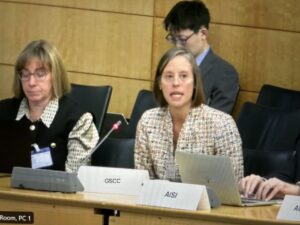
Adler points out in this context the energy advantages, highlighting the availability of natural gas as a crucial transitional phase for reducing emissions compared to coal-based production, in addition to the immense potential of solar and wind energy.
She also emphasizes that the strategic location close to major export markets, primarily the European market, is among these solid industrial foundations.
Adler stresses that transforming these advantages into a sustainable competitive reality requires extensive investments in modern electricity grids, infrastructure, the provision of high-quality raw materials, as well as the establishment of precise emission measurement systems.
In response to questions about whether green steel standards represent a new protectionist tool for developed countries, Adler explains that the Global Steel Climate Council strictly adheres to the principle of “technological neutrality”; no production pathway is inherently favored. The true and only standard is the “actual measured emissions” of the final product, regardless of the technology used.
Regarding border policies such as the European Carbon Border Adjustment Mechanism (CBAM), Adler asserts that any border measure must be based on scientific and transparent measurement that accurately reflects full emissions within defined boundaries, without allowing for emission reductions through accounting loopholes. She emphasizes that the GSCC is not a commercial lobbying group but a standard-setting body seeking to unify global measurement rules.
Adler warns that the ability to Measure, Report, and Verify (MRV) could become a more stringent competitive constraint than the cost of decarbonization itself, explaining that a plant might produce low-emission steel, but if it fails to prove this through reliable data audited by accredited international bodies, it will lose its place in global markets. She noted that the Steel Climate standard covers all three emission scopes (Scope 1, 2, 3), aiming to reach a company emission intensity of approximately 0.12 tons of CO2 equivalent per ton of hot-rolled steel by 2050.
The Executive Director of the Global Steel Climate Council concludes her vision by emphasizing that the true winner in the future steel market by 2035 will be the one who can prove their carbon footprint, by succeeding in combining three essential elements: reliable, low-emission energy at competitive prices, resources and raw materials suitable for the conditions of each industrial facility, and a genuine, proven ability to measure carbon performance with transparency and independent certification.
** Adina Rene Adler has been the Executive Director of the Global Steel Climate Council since December 2023, with over two decades of experience in industrial and trade policies. Her academic background combines international affairs, economics, and law, balancing economic growth with environmental sustainability.